Why Generic CRMs Fail in Education

Have you ever wondered why your admissions team still spends hours in spreadsheets despite having a high-priced CRM? It is a common frustration. You were promised a unified view of your students, yet your data remains siloed, your marketing feels impersonal, and your reporting is a mess.
The truth is that many institutions fall into the trap of choosing a “one-size-fits-all” solution. These generic CRMs are built for the B2B widget and software subscription market. But education is different. You aren’t selling a product; you are guiding a life-changing journey. When a system built for selling coffee machines tries to manage a student’s academic future, things break.
Why do 70% of digital transformations in complex sectors struggle to meet their initial goals? According to research by McKinsey & Company, this high failure rate is often due to:
A lack of employee engagement, inadequate management support, and poor cross-functional collaboration.
Boston Consulting Group (BCG) echoes this, noting that:
70% of digital transformations fall short of their objectives, primarily when they prioritize technology over the “people dimension” of the organization.
Often, the problem is that the platform architecture cannot handle the unique human relationships that define a school or university. To achieve true growth and efficiency, you need an Education CRM strategy that prioritizes the student, not just the “lead.”
The Architecture Gap: Students vs. Customers
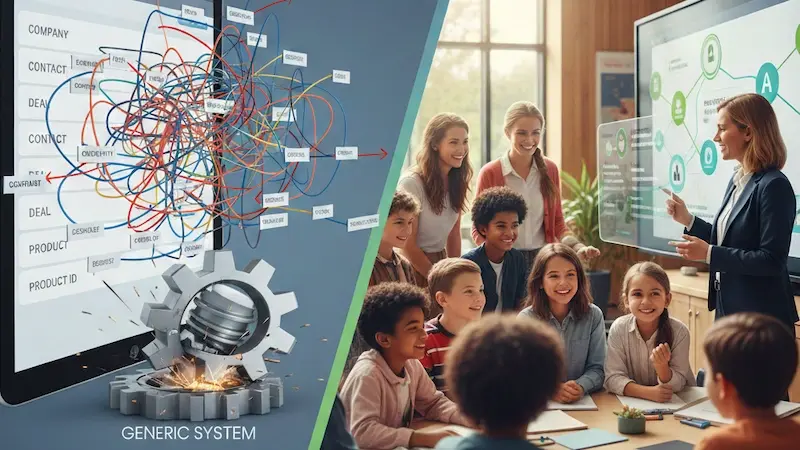
If you look at a standard, generic CRM, you will see a rigid hierarchy: Company > Contact > Deal. This works perfectly if you are selling office supplies to a corporation. In that world, the Company is the buyer, the Contact is the person you talk to, and the Deal is the transaction.
But how does this map to a primary school or a graduate program? It doesn’t.
In education, the “customer” is often a complex unit. Is it the student? Is it the parent paying the tuition? Is the grandmother the primary emergency contact? A generic CRM usually forces you to pick one. If you list the parent as the primary contact, you lose the ability to track the student’s specific academic interests. If you list the student, you lose the billing connection to the parent.
This is where the need for “Many-to-Many” relationships becomes vital. This is where one record can link to many records, and vice versa. One parent might have three children at the same school, each in different grades with different extracurricular needs. One child might have two parents living at different addresses. A generic system often creates duplicate records to handle this, leading to what we call dirty data.
According to a report by Salesforce,
74% of higher education institutions say that “siloed data” is their biggest obstacle to student success.
When your data is siloed, your team cannot see the full picture. You might send a “Plan a Visit” email to a parent who has already visited three times this month.
To solve this, modern institutions are moving toward platforms that support Custom Objects. Instead of forcing your school into a Company box, you can create objects for Applications, Enrollments, or Scholarships. This allows the CRM to fit your business model, rather than forcing you to change how your school operates just to satisfy the software.
A CRM does not live on an island. For a school to run smoothly, the CRM must talk to the Student Information System (SIS). Whether you use iSAMS, PowerSchool, or Veracross, this integration is the heartbeat of your RevOps strategy.
Generic CRMs often claim to “integrate with everything,” but they usually mean they have a basic API. They don’t understand the specific data fields required by an Admissions Registrar. When the CRM and the SIS don’t communicate in real time, friction is the inevitable result.
Imagine this scenario:
A prospective student changes their course preference from Biology to Fine Arts in the SIS during an interview. However, the generic CRM doesn’t receive that update. Your marketing automation continues to send that student “Top 10 Science Lab Features” emails.
Not only is this a waste of resources, but it also signals to the student that you aren’t actually listening to them.
This lack of synchronization leads prospective students to move away from your institution. Or, as we’ve mentioned before, “leads rotting on the vine.” If an admissions officer has to manually export data from one system and import it into another, they are losing time that should be spent building relationships.
Research indicates that companies lose an average of $12.9 million per year due to poor data quality.
In education, that loss isn’t just financial; it’s a loss of institutional reputation.
RevOps in Education: Aligning People, Process, and Platform
You might think “Revenue Operations” (RevOps) sounds like a corporate buzzword that doesn’t belong in a school. But at its core, RevOps is just about alignment. It is the practice of ensuring that your Marketing, Admissions, and Student Services teams are all looking at the same map.
In many schools, these departments operate like independent nations. Marketing generates interest, Admissions handles the applications, and Student Services takes over once the student arrives. Between each handoff, information is lost.

A specialized Education CRM strategy uses the RevOps framework to break these silos. When your platform is aligned, your marketing team knows exactly when a student has paid their deposit. They can instantly trigger a “Welcome to the Family” sequence and stop the “Apply Now” reminders.
This alignment reduces the financial and logistical problems caused by inaccurate data. When everyone trusts the platform, you don’t need weekly reconciliation meetings to figure out which spreadsheet is the source of truth. You simply log in and see the truth in real-time. This allows your leadership to make better enrollment forecasts and budget decisions based on facts rather than gut feelings.
Beyond the “B2B” Label: The Unique Student Journey
The sales cycle for a school is unlike almost any other industry. In B2B, a deal might close in three months. In education, a parent might start researching a school when their child is three years old, for enrollment that won’t take place for another two years. This 12–24-month journey requires a very high level of nurturing.
Generic CRMs are often built for speed. They want to move a lead from New to Closed as fast as possible. But in education, pushing too hard too fast feels transactional and cold. The tone needs to be inquisitive and supportive. You are asking questions about a child’s dreams, their struggles, and their potential.
Data shows that 80% of students and parents say that a personalized experience is just as important as the quality of the education itself.
If your CRM can’t remember that a student loves soccer or plays the cello, you can’t provide that personalized experience.
A generic system makes personalization hard because it doesn’t have the “bins” to store that specific information. A tailored system allows you to tag a student’s interests and automatically invite them to the Spring Concert rather than just a general Open House. This level of detail is what builds the trust necessary to move a family from “considering” to “enrolled.”
The Impact of a “One-Size-Fits-All” Mentality
Why do schools keep buying generic tools? Usually, it is a matter of brand recognition or a lower initial price point. However, the “sticker price” of a CRM is only a small part of the Total Cost of Ownership (TCO).
When you use a generic tool, you pay for it in other ways:
-
Manual Workarounds: Your team member spends 10 hours a week cleaning data.
-
Fragmented UX: Parents get frustrated by receiving redundant forms.
-
Low Adoption: Your team hates the software because it feels “clunky,” so they go back to using their own private Excel sheets.
Is your current system actually saving you time, or just creating more work? If your admissions team feels like they are working for the software rather than the software working for them, it is a sign that the architecture is a mismatch.
Evaluating the Right Fit: What to Look For
If you are currently in the consideration stage of your journey, you need to look past the flashy dashboards of a generic CRM. Instead, ask these technical questions:
-
Can the platform handle complex family trees? You need to link multiple contacts to multiple households without breaking the data structure.
-
Does it support native integrations with my SIS? Avoid “custom-built” bridges if possible; they are expensive to maintain and prone to breaking during updates.
-
Can we build Custom Objects? Ensure you can create categories like Financial Aid Applications or Alumni Donations that function just as smoothly as a standard contact record.
-
Is the onboarding specialized? Generic onboarding teaches you how to click buttons. Specialized onboarding teaches you how to manage an enrollment funnel.
In fact, schools that move from a legacy, generic system to a tailored environment—such as a HubSpot setup optimized for education with custom objects—often see a reduction in manual data entry of up to 40%.
That is 40% more time your team member can spend talking to prospective families.
Building a Foundation for Growth
The goal of any school is to grow—not just in numbers, but in the quality of the community it builds. You cannot build a modern community on an archaic, generic foundation. Generic CRMs fail in education because they treat people like transactions. They ignore the nuances of the student lifecycle and the complexity of parent relationships.
Success in the digital age requires a shift in mindset. It requires adopting a RevOps philosophy in which the platform, people, and processes all pull in the same direction. When you have an Education CRM strategy that actually reflects the reality of your school, the results are transformative. You see higher engagement, cleaner data, and a more stressed-out admissions team becomes a more productive, happy one.
At Aspiration Marketing, we understand that schools have unique DNA. We have expertise in helping educational institutions navigate these complex digital transformations. We don’t just “set up software”; we align your RevOps to ensure your CRM—whether you use HubSpot or another powerful tool—is perfectly tailored to the student journey. We help you move away from the “generic” and toward a system that drives sustainable growth and fosters meaningful connections.
Are you ready to stop fighting your CRM and start using it as a growth tool? Let’s look at how we can tailor your platform to fit your school’s unique needs.