Which One Works for Your Business?


There’s no shortage of questions in marketing that need answers. Some are benign, such as “how does my product help?” Others are far more uncomfortable, especially when it comes to attribution models. What are they, and why are they a touchy subject? Well, attribution models are the rules that determine which marketing touchpoints receive credit for a conversion.
This is when the tough questions begin.
Did the first paid ad create the demand? Did the final email push someone over the line? Or did five small interactions, spread over weeks, quietly stack up?
This changes how you see your marketing system, in practical choices: which campaigns you scale, which experiments you kill, which reports you trust in Monday meetings. When you understand which touchpoints are actually influencing conversions, allocation stops being instinct-driven. It becomes deliberate.
Below, we’ll walk through the common attribution models, which ones hold up under pressure, and how to choose the approach that fits your business as it operates today, not the version you wish you had.
The Importance of Attribution in Marketing
Attribution shapes almost every meaningful decision in marketing.
If you rely on last-click conversions alone, you’ll usually overfund whatever shows up at the end of the journey. That could be branded search or retargeting ads.
Those channels look efficient because they’re close to the finish line. Meanwhile, the early work that sparked interest in the first place gets undervalued. Over time, demand thins out. Then growth stalls.
Jeff Zhou, CEO and Founder of Fig Loans, sees this distortion clearly in lending, where trust builds gradually long before an application is submitted.
Zhou says,
“By the time someone applies for a loan, they’ve usually returned multiple times. They’ve read FAQs, compared options, and evaluated whether they trust you. If you only credit the final click, you miss the interactions that actually reduced uncertainty. We’ve learned that the early educational touchpoints often matter more than the conversion event itself, even though they rarely show up that way in last-click reporting.”
This is where attribution really matters.
When credit is distributed more accurately, investment shifts. Google reports that
Advertisers who move from last-click to data-driven attribution see roughly a 6% lift in conversions at the same spend.
That lift doesn’t come from new channels or bigger budgets. It comes from reallocating spend toward the touchpoints that were already influencing decisions but weren’t getting recognized.
Overview of Common Attribution Models
There isn’t a universally correct attribution model. Each one reflects a belief about how decisions actually happen.
 Some assume the final interaction matters most. Others assume the first touch deserves protection. Some spread credit evenly because influence is hard to isolate. Others try to model reality more closely using observed patterns across thousands of journeys.
Here’s what each model is really doing behind the scenes.
-
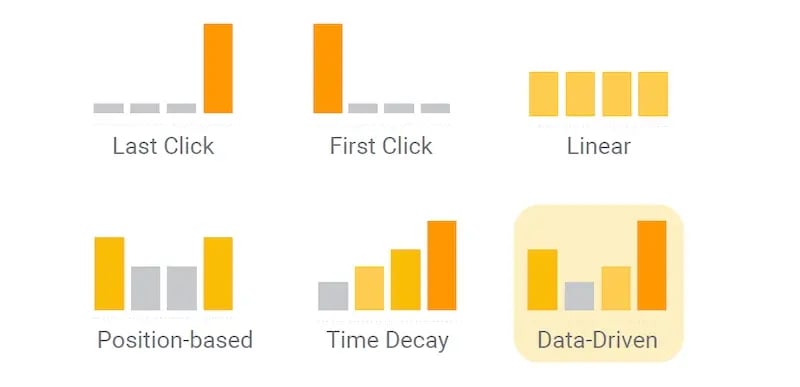
Last-click gives full credit to the final interaction before conversion. This is why branded search and retargeting campaigns often look dominant in reports.
-
First-click does the opposite. It protects the very first interaction, the ad, post-hookup, or referral that introduced someone to you.
-
Linear splits credit across every recorded touchpoint. No favorites.
-
Time-decay increases the weight of interactions that happened closer to the conversion, while still acknowledging earlier touches.
-
Position-based models prioritize the journey’s edges. The first interaction created interest. The last interaction that closed it. Everything in between shares the remainder.
-
Data-driven attribution moves away from fixed rules entirely. Instead, it analyzes patterns across real customer paths and assigns credit based on observed impact, not assumptions.
Google’s Analytics and Ads platforms offer detailed documentation if you want to see how these models are implemented technically.
But the real difference shows up in decisions. Not definitions.
Last-click Attribution
Last-click attribution gives all the credit to the final interaction. In practice, that’s often a branded search, retargeting ad, or direct visit.
 This model is popular because it’s clean. Easy to explain, and easy to defend in meetings.
It answers one narrow question very well: what closed the deal?
But it ignores everything that created the opportunity in the first place. The initial ad someone clicked three weeks earlier. The comparison guide they read. The webinar they attended. None of it gets recognized.

Over time, this skews investment toward bottom-of-funnel channels. Teams scale what appears to convert and quietly cut the channels that actually created demand.
Last-click works as a closing lens, but becomes dangerous when treated as the full story.
First-click Attribution
First-click attribution assigns full credit to the first recorded interaction.
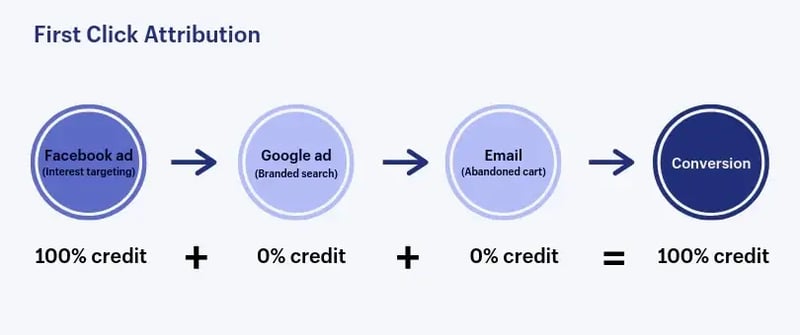 This protects the channels responsible for generating net-new interest. Paid social. Content. Partnerships. Awareness campaigns that don’t convert immediately but start the process.
It’s especially useful when awareness budgets are under pressure. First-click makes it visible.
But it has its own blind spots. It undervalues everything that nurtures and converts that initial interest. Email sequences. Retargeting. Or sales conversations.
Awareness matters. So does follow-through.
Linear Attribution
Linear attribution treats every touchpoint equally. This makes it one of the safest starting points for teams with complex journeys.
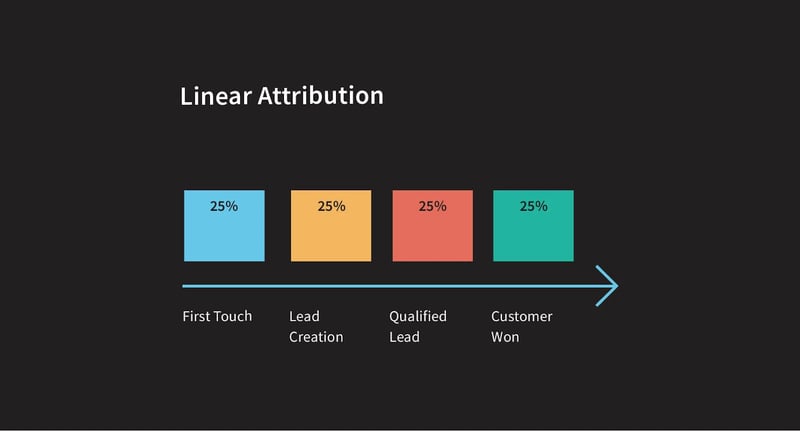 No channel gets ignored. No stage gets artificially inflated.
It’s especially useful in B2B environments, where conversions often involve multiple interactions over weeks or months, webinars, demos, case studies, and sales follow-ups.
But linear attribution lacks precision. It assumes every touch contributed equally, which rarely reflects reality. Some touches move decisions forward. Others barely register.
Still, it prevents tunnel vision. And sometimes that’s the priority.
Time-decay Attribution
Time-decay attribution increases credit for interactions closer to conversion.
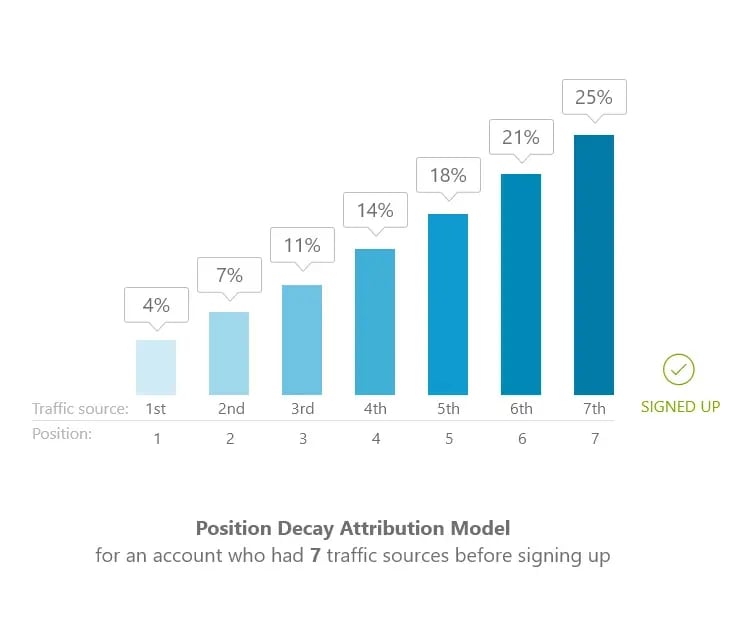 This goes well with fast-moving purchase cycles. Retail promotions. Seasonal campaigns. Situations where recency strongly predicts action.
Someone who clicked an ad yesterday matters more than someone who casually browsed a month ago.
Earlier touches still count. They just carry less weight.
The tradeoff is predictable. Customer awareness and early exploration can appear less valuable, even when they created the initial interest.
Position-based Attribution
Position-based attribution gives most of the credit to the first and last touchpoints, often using a structure like 40 percent to the first interaction, 40 percent to the last, and the remaining 20 percent split across the middle.
 This reflects how many journeys actually unfold.
Someone discovers you. Then they convert. The middle interactions help, but those two moments carry disproportionate weight.
This model often surfaces insights that last-click hides. The structure itself is still a rule of thumb. The weights are predefined, not discovered.
But it’s often closer to reality than single-touch models.
Matthew Thompson, Founder of OwnerWebs, found that focusing on both entry and conversion points revealed patterns that single-touch models missed entirely.
Thompson says,
“We saw cases where prospects discovered us through a directory or referral, disappeared, and then returned weeks later through branded search to convert. Last-click made it look like branded search was doing all the work. Position-based attribution showed that discovery and intent were happening much earlier. Once we saw that clearly, it changed where we invested.”
Data-driven Attribution
Data-driven attribution uses observed behavior instead of fixed rules.
It analyzes how different touchpoints influence outcomes across many journeys and assigns credit based on actual impact. Techniques like Shapley values or counterfactual modeling help isolate which interactions changed the conversion probability.
When sufficient data is available, this is the most accurate view.
 But it comes with requirements. Clean tracking. Consistent tagging. Enough conversion volume to support meaningful analysis. And stakeholder trust in a system they can’t manually verify step by step.
Data-driven attribution works best when you have complex customer journeys with multiple touchpoints. The algorithms can identify subtle interaction effects between channels that manual analysis would overlook. For businesses with at least 600 conversions per month, this approach often yields the most accurate credit distribution.
Without sufficient volume, the model can’t learn. And without trust, it won’t be used.
Christopher Skoropada, CEO of Appsvio, sees attribution clarity improve significantly when teams move beyond fixed rules and start analyzing full usage patterns.
Skoropada says,
“In SaaS, the moment someone converts is rarely the moment they decided. They may have explored the product weeks earlier, seen a walkthrough later, and only upgraded after reaching a specific need. When we began analyzing complete interaction paths instead of isolated clicks, it became clear which touchpoints were actually moving users forward. That changed how we prioritized both product education and acquisition.”
Choosing the Right Attribution Model for Your Business
Start with how your business actually operates.
How long does it take someone to convert? How many touchpoints are typical? How reliable is your tracking?
These answers matter more than theoretical accuracy.
Your attribution model should reflect your business reality. E-commerce businesses with short sales cycles might thrive with time-decay attribution, while B2B companies with lengthy consideration phases often benefit from linear models.
The key is understanding your unique customer journey before selecting a model:
A few diagnostic questions help clarify readiness:
-
Do you know your typical sales cycle length?
-
How many touches does a typical conversion involve?
-
Which stage currently appears undervalued?
-
Is your tracking consistent and reliable?
-
Do you have enough conversions for data-driven modeling?
-
Can leadership understand the model quickly?
-
Will the insights actually change spending decisions?
If most answers are uncertain, simpler models are safer.
Future Trends in Attribution Modeling
Privacy changes are forcing attribution to evolve.
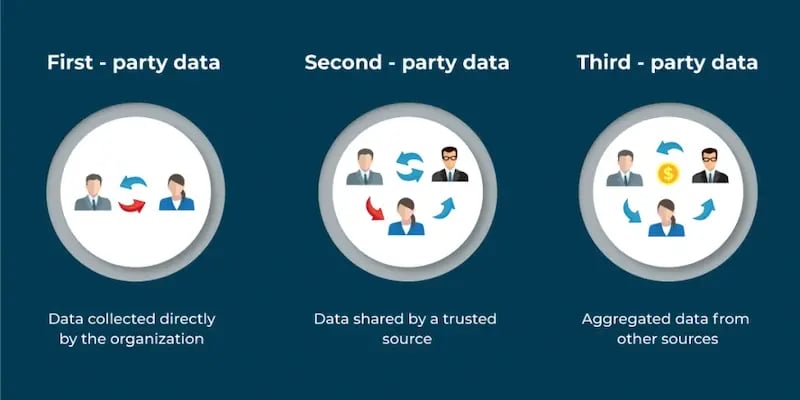
Privacy-first attribution is becoming essential as third-party cookies are phased out. Smart marketers are investing in first-party data collection and exploring probabilistic models. The businesses that adapt now will maintain their competitive edge as the digital landscape evolves.
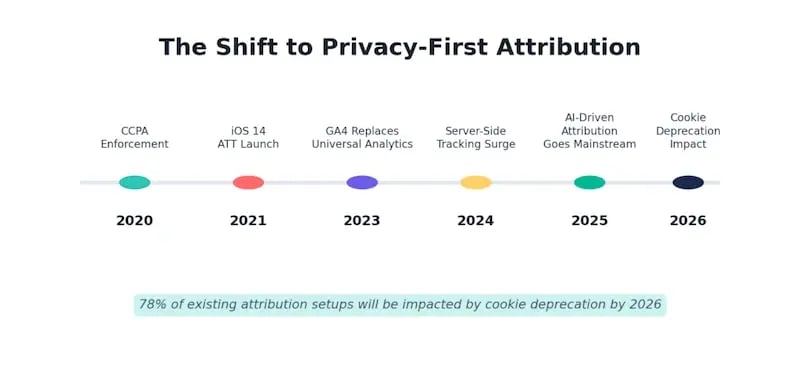 Deterministic tracking is becoming less reliable. Modeled attribution is becoming standard.
Ryan Walton, Program Ambassador at The Anonymous Project, sees attribution shifting toward broader pattern recognition as tracking becomes less deterministic.
Walton says,
“We’re already seeing situations where the full customer path isn’t visible in one place anymore. People move between platforms, devices, and anonymous interactions. Attribution now requires understanding behavioral patterns, not just recorded clicks. The organizations adapting fastest are the ones building systems around incomplete but directional data.”
This means heavier reliance on first-party data, consented identifiers, server-side tracking, and aggregated reporting.
 Hybrid measurement approaches are becoming more common, multi-touch attribution for digital journeys combined with broader modeling techniques to capture offline and indirect effects.
AI-driven attribution is also becoming the default in many platforms, as it handles complexity better.
Customer journeys are fragmented. Channels overlap. Attribution systems have to keep up.
Research from Harvard Business Review shows that omnichannel customers tend to spend more and remain more loyal. That makes accurate cross-channel attribution more than a reporting exercise. It becomes operational infrastructure.
Making a Decision
Choosing an attribution model isn’t about theoretical accuracy. It’s about decision quality.
Start with something usable. Ensure the insights inform spending decisions. Then evolve as your data and tracking improve.
The right model is the one your team trusts enough to act on.
If you want a deeper look at how attribution models work in practice, and how to apply them without overcomplicating your reporting, Aspiration Marketing has a helpful breakdown of the options and tradeoffs.