Which CRM is the Right Engine for Sales Growth?


Are your sales teams maximizing every single lead, or are they wrestling with scattered tools and frustrating data silos? If you feel your current setup is bottlenecking your growth, you’re not alone. The right platform is not just a digital tool; it is the essential infrastructure for building predictable revenue and optimize sales management.
As you look to scale, you face a critical decision: should you invest in a comprehensive Customer Relationship Management (CRM) platform, or should you choose a hyper-specialized Sales Engagement Platform (SEP)?
This is the consideration stage of your software journey, and the stakes are high. We will dive deep into the primary capabilities of HubSpot’s integrated customer platform versus the focused sales acceleration power of Outreach. Our goal is simple: to help you determine which strategy builds the strongest, most efficient foundation for your business’s future.
The Non-Negotiable Foundation: Why You Need a Strategic CRM
We need to be clear: a CRM is not merely a shared digital address book. It is a revenue engine that centralizes all customer data. It connects every customer touchpoint, from the first marketing click to the final sale and beyond. If you do not have a robust CRM, you are not just missing out on automation; you are hemorrhaging productivity.
Are you surprised by how often key prospect information is locked in a salesperson’s personal email or a forgotten spreadsheet? It’s a widespread problem that dramatically slows deal velocity.
The Cost of Inefficiency is Real
The data confirms this struggle:
At this stage, the debate is not if you need a CRM. The core question is which architectural approach—a single, unified platform or a collection of specialized accelerators—will best serve your unique growth trajectory.
Defining the Contenders: Platform vs. Hyper-Specialization
To choose your path, you first need to understand the philosophy behind each solution. They are built to solve two slightly different problems.
HubSpot: The Integrated CRM Ecosystem
The HubSpot CRM is more than just software; it is a comprehensive customer platform built on a unified data model. It connects your marketing, sales, service, and operations on one single source of truth.
-
Core Philosophy: HubSpot aims to eliminate friction between all front-office teams. The goal is a seamless customer journey where marketing hands a lead to sales, and sales hands a customer to service, without any data gaps or clumsy handoffs.
-
The Power of Integration: The platform’s greatest strength is providing a holistic, 360-degree view of the customer. This enables sales reps to have the full history of a prospect’s web visits, form submissions, and previous interactions at the moment they reach out.
-
Target User: This system is ideal for businesses prioritizing scalability, a unified data source, and strong alignment across their entire go-to-market strategy.
Outreach: The Specialized Sales Engagement Platform
Outreach is a specialized Sales Engagement Platform (SEP). It focuses intensely on helping sales development reps (SDRs) and account executives (AEs) execute high-volume, automated, and personalized sequences for efficient outbound prospecting.
-
Core Philosophy: Its primary focus is on accelerating the sales motion. It is built to maximize the efficiency and effectiveness of the person responsible for the first contact.
-
Specialized Strength: It offers deep, specialized tools for multi-channel sequencing, detailed prospect engagement tracking, and call analysis. It is a true accelerator for sales tasks.
-
Target User: Sales-focused organizations, typically with dedicated SDR/BDR teams, that require maximum volume and optimization of their outbound process.
To sum it up, the keyword at the heart of this discussion, “outreach,” describes the primary function and strategic intent of this platform.
Feature Face-Off: A Data-Driven Comparison
You cannot make this decision on reputation alone. You must compare the core performance areas using real-world data to see which platform truly aligns with your strategic goals.
1. Performance in Pipeline Management and Forecasting
Which tool helps you manage the entire sales landscape, not just individual prospecting tasks?
.webp?width=800&height=769&name=Hubspot%20vs%20outreach%20table%201%20(1).webp) The Strategic Advantage: HubSpot’s comprehensive view is designed for sales leaders to visualize, manage, and forecast the entire buyer journey. Its strength is attributing revenue back to the original marketing source seamlessly because of the unified platform.
The Strategic Advantage: HubSpot’s comprehensive view is designed for sales leaders to visualize, manage, and forecast the entire buyer journey. Its strength is attributing revenue back to the original marketing source seamlessly because of the unified platform.
In contrast, Outreach excels at executing tasks within the pipeline, but it is not built to be the core repository for the financial architecture of the sales motion.
2. Sales Execution and Multi-Channel Sequencing
Here, we look at where the rubber meets the road: the daily tasks of prospecting.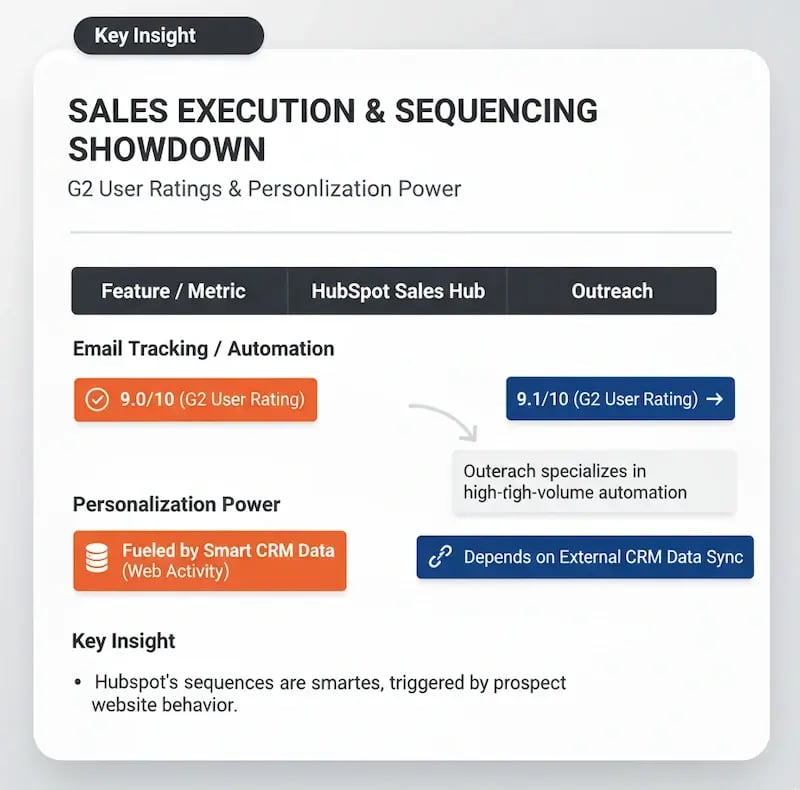
The Strategic Advantage: Outreach is arguably the market leader in the very specific task of high-volume sales outreach. Its platform offers granular control over complex, multi-step cadence sequences that ensure every lead receives a specific number of touchpoints across various channels.
However, HubSpot’s strength lies in making the automation smarter. An automated step in a HubSpot sequence can trigger based on a prospect’s behavior across your website—an engagement signal only possible with a unified CRM platform.
3. Ease of Use, Adoption, and Scalability
A tool’s power means nothing if your team refuses to use it. User adoption is the single biggest factor in CRM success or failure.
-
Adoption is Critical: Research shows that poor user adoption is the leading cause of CRM project failure.
-
User-Friendly Interface: HubSpot is recognized for superior ease of use, scoring 8.7 from users on G2. Its intuitive interface leads to faster implementation, lower training costs, and higher sales team adoption. Outreach scores 8.3, and users often report a steeper learning curve due to its dense, specialized features.
-
Scaling Architecture: As your business adds Marketing, Service, or Operations teams, a unified platform like HubSpot CRM drastically reduces the cost and complexity of integration. Using Outreach means you need a second tool to serve as the core CRM, and then a third platform for marketing, forcing you to constantly manage the connection between multiple systems. This “Frankenstein Stack” creates maintenance headaches that slow your growth.
The Ultimate Deciding Factor: Unifying Marketing and Sales
The single greatest competitive advantage today is customer experience. You cannot deliver a great experience when your Marketing team views the customer one way and your Sales team sees them another.

The Problem with Fragmentation
A specialized tool like Outreach is excellent at accelerating sales execution, but you must ask a critical, consideration-stage question:
Do you want a platform that connects your teams, or one that requires you to manage the connections between them?
Sales engagement platforms are often built on top of a separate CRM. HubSpot, on the other hand, is the core CRM, making it the most seamless solution.
Why the Unified CRM Wins
For a consideration-stage business, the goal is not just to execute tasks but to power growth. The integrated nature of HubSpot CRM provides tangible growth acceleration:
-
Lead Velocity Acceleration: The unified platform delivers proven results. After just one year, HubSpot customers acquire 129% more leads and close 36% more deals, showcasing the exponential power of synchronized Marketing and Sales efforts.
-
Holistic Data for Personalization: With a single customer record, your sales reps can stop guessing. They can see what blog post a prospect read, what form they submitted, and what support ticket they opened. This complete context allows for genuinely personalized outreach—a critical factor in building trust and accelerating the deal cycle.
-
Reduced Total Cost of Ownership (TCO): Over time, consolidating on one integrated platform is simpler and more affordable than licensing, integrating, and maintaining three separate, highly complex enterprise tools (CRM + Sales Engagement + Marketing Automation).
Making the Strategic Investment
The choice between the two platforms boils down to a fundamental strategic decision:
-
If your singular, immediate challenge is maximizing high-volume outreach and optimizing SDR sequences with laser-like focus, Outreach is a powerful, highly specialized tool.
-
If your goal is sustainable, cross-departmental growth—where sales is perfectly aligned with marketing and service on a unified data source—the architecture of the HubSpot CRM platform is the definitive strategic winner. It empowers you to not just close deals faster, but to build better customer relationships that drive long-term value and predictable revenue.
This decision is foundational, and navigating the migration, integration, and training process successfully requires more than just reading comparison charts. It demands true expertise.
This is precisely where Aspiration Marketing excels. We leverage our deep expertise in HubSpot CRM implementation and optimization to design custom revenue operations that drive quantifiable results. We ensure your platform choice translates directly into sustainable business growth.
Take the next step: Consult with our specialists to unify your sales and marketing technology stack today.