What High-Performing Digital Experiences Have in Common


In marketing, they say that the product is the most important thing. In most cases, it’s really not. The truth is, your ability to convert leads into customers doesn’t depend solely on the quality and value of your products and services. Nor is it entirely dependent on the effectiveness of your advertising campaigns.
Instead, the success and growth potential of any brand (operating in any industry or market) depend directly on the enjoyability of the digital experiences it provides to its prospects.
What does that mean? Below, you’ll learn:
- The characteristics that high-performing digital experiences have in common
- actionable tips for incorporating these CX elements into your online presence
- Examples of real-life brands employing these strategies to engage and convert new clients
But before we dive into all that, it would be helpful to understand the key reasons why digital brand experiences are so powerful in guiding buyers through the sales funnel, and what influences buyer decisions.
Why Customer-Brand Interactions Matter
For starters, most people interact with several brands daily, multiple times a week. Some data even suggests that people see between 4,000 and 10,000 brand messages every day, which could potentially explain the growing tendency to ignore irrelevant brand messaging.
However, the omnipresence of online brand touchpoints isn’t the only thing influencing consumers’ quest for high-quality, meaningful digital experiences. Instead, buyers are slowly but steadily replacing offline brand interactions with digital experiences, using the web for every step of the buyer’s journey: from awareness to purchase. In fact, recent data indicates that e-commerce accounted for over 23% of all global retail sales in 2025.
With this in mind, one of the key considerations for winning over new clients (and keeping existing ones around) is to give these prospects precisely what they seek. And that appears to be a superior customer experience. The only way to do that is to understand the characteristics of buyer awareness.
Based on the latest consumer behavior research, CX has become synonymous with value.
According to Deloitte’s 2026 Retail Industry Global Outlook report,
4 in 10 Americans now demonstrate value-seeking behaviors when shopping online.
But what’s fascinating is that value doesn’t necessarily correlate with affordability.
Instead,
40% of consumers’ perceptions of a brand’s value depend on factors such as quality, customer service, ease of checkout, loyalty programs, employee attitudes, and other elements of the customer experience.
So, if you want to design a superior customer experience that brings satisfaction at every touchpoint (and actively moves prospects from the top to the bottom of your sales funnel), you need to enrich your digital presence with UX design that drives customer satisfaction.
Here’s how to do that.
Clear Purpose on Every Page, No Guessing
Consumers expect brands to demonstrate an in-depth understanding of their wants and needs. Perhaps even more importantly, they demand hyper-relevant solutions and personalized experiences,
With 76% of online buyers feeling disappointed when brands fail to deliver customized interactions.
However, while relevance is accomplished by optimizing digital marketing campaigns and tailoring messaging to align with each prospect’s unique buyer’s journey, there’s a much simpler method to design a high-performing digital experience: combining the power of clarity and purpose.
By maintaining a strong focus on what your brand offers and what it can do for your target audience, you can effectively engage your ideal customer personas and draw them into your sales funnel.
More importantly, by creating clarity about what web visitors need to do to move closer to resolving their pain points, you can build highly goal-oriented digital experiences that show a clear path from problem to solution for your target audience.
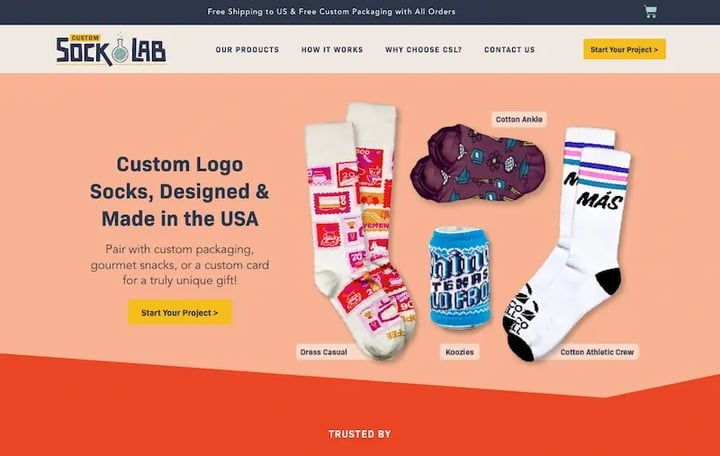
The Custom Sock Lab website is an exceptional example of this strategy in practice.
If you check out the brand’s homepage, you’ll immediately understand what the company does, who its products are for, and what prospects need to do to enter the buying journey. This is all accomplished through straightforward messaging and product-led visuals, supported by action-oriented CTAs that create clarity and purpose at each step (leaving zero room for visitors to engage in guesswork about what they need to do next to solve their needs).
Design That Guides Attention Instead of Competing for It
Web design plays a major role in determining the enjoyment of brand interactions for your prospects.
Consumers prefer to interact with content that’s beautifully designed and easy to use. Scientific research also suggests that they (subconsciously) make buying decisions based on the quality of web design.
What’s fascinating, however, is that great design isn’t just aesthetically pleasing. It also needs to be easy to use and navigate, highly reliable, fast, and feature a focused, goal-oriented layout.
So, how can you use your site’s design to create high-performing digital experiences that drive conversions?
One method would be to focus on design choices that engage your visitors’ attention, then logically guide prospects toward a desirable outcome.
Considering that most web users prefer simple, familiar websites, minimizing site distractions and creating logical pathways to pain-point resolution can be an effective tactic for creating high-converting digital experiences.
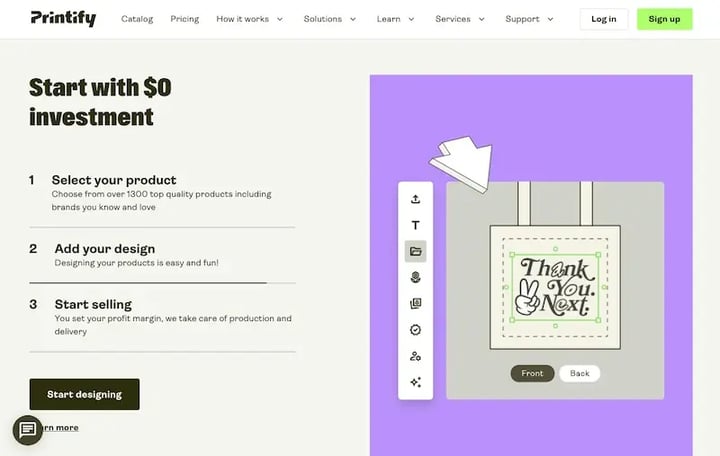
The Printify homepage is an excellent example of what this looks like in the real world.
This brand’s homepage design veers towards minimalism, and not for purely aesthetic reasons. The design direction has a genuine usability purpose — gradually educating visitors about the brand’s offer and guiding them toward a confident conversion decision. The ‘Start with $0 investment’ section, along with the social proof, effectively outlines the process and benefits of using Printify’s services. Lastly, the trust-building microcopy addresses common conversion obstacles, preventing risk-averse prospects from leaving the sales funnel before they’ve fully grasped the benefits Prinfity offers.
Messaging That Matches User Intent at Every Stage
When landing on your website, prospects are likely to have a specific goal in mind. In marketing, this is called user intent.
At its core, user intent refers to the purpose behind each web visitor’s online search. It can be informational, navigational, transactional, or commercial.
When optimizing your website for an enjoyable digital experience, ensure you align with your prospects’ intent at every stage of their buyer’s journey.
Ultimately, the best way to accomplish this goal is to create web copy (and choose digital content) based on what your target audience wants and needs from your brand.
In addition to addressing customer concerns, motivations, and questions, it’s also crucial to align your value propositions with any additional purchase-influencing factors.

For instance, most consumers make value-based buying decisions and expect brands to be active in their pursuit of the greater good. By addressing these sentiments in your messaging and associating your offer with the outcome your prospects want to achieve, you can create a digital experience that effectively converts new clients.
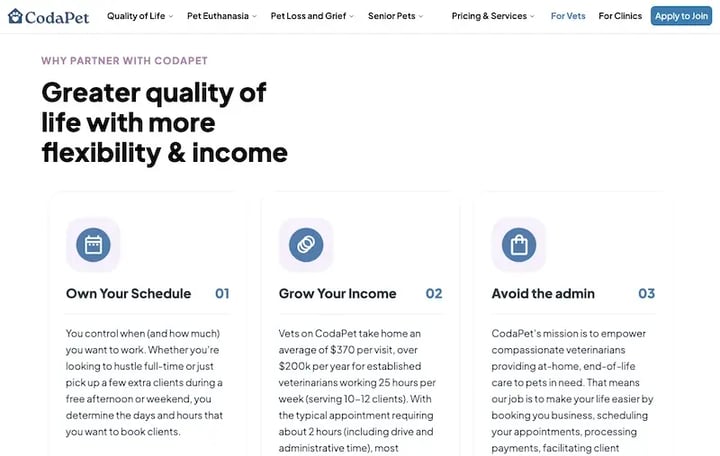
Take a look at the Coda Pet Vets landing page.
This brand targets a highly specific audience whose motivations and desired outcomes are fully unique. To present them with a relevant and enjoyable browsing experience, Coda Pet optimizes its copy to align with this audience’s emotional state. The web content covers intent-related topics, including ethical care, professional standards, emotional burden, and logistics. The brand does so knowing that aligning messaging in this way helps match user intent across the buyer’s journey, elevating conversion rates and brand reputation.
Simple Navigation That Reduces Cognitive Load
Designing high-performing digital experiences often means giving your prospects precisely the type of brand touch they seek.
So, what do consumers want from web browsing experiences? Usability, obviously, ranks high on their list of demands (along with aesthetic appeal and convenience). However, when it comes to specific web features that people want more of,
Easy navigation ranks highest for 94% of users.
The reason for this is pretty straightforward. Navigation doesn’t just facilitate movement through the sales cycle; it also allows shoppers to map out their browsing journey, helping them know where they are and where they can go at any point of the shopping process.
That’s why it’s crucial that your website features a highly visible, user-friendly navigation menu. This navigation menu must also work for your prospects, reducing their cognitive load by preventing them from getting lost or becoming overwhelmed at any point in the buying journey.
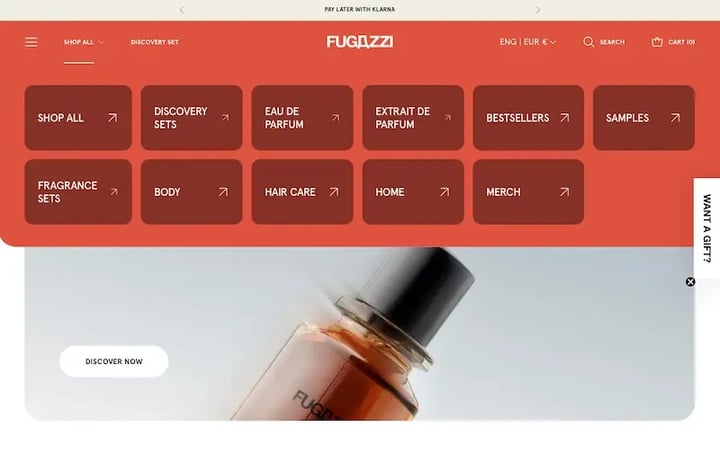
Take a look at how Fugazzi uses navigation to ease movement through the sales funnel.
This brand understands that its target audience enjoys niche fragrances. However, it also knows that this doesn’t necessarily mean potential buyers appreciate complex digital experiences. That’s why Fugazzi created a completely straightforward navigation menu. It enables shoppers to choose the type of fragrances they wish to browse, or to navigate to product collection pages designated for discovery sets, body, and hair care products.
Trust Signals Embedded Throughout the Experience
Brand credibility and trustworthiness play an irreplaceable role in influencing movement through the sales funnel. And when it comes to designing digital experiences that convert, reinforcing trust genuinely stands out as an effective CX tactic.
The reason for this is simple. Consumers don’t want to interact with (or buy from) businesses they don’t trust. According to research,
81% of shoppers consider trust a deciding factor influencing their buying decisions.
Moreover, new data from Shopify reveals that brand trust significantly improves sales performance, with
68% of people who are willing to pay more for solutions from brands they trust.
To design a digital experience that nurtures trust and drives conversions, one of the easiest ways is to embed trust signals throughout your prospects’ browsing journey.
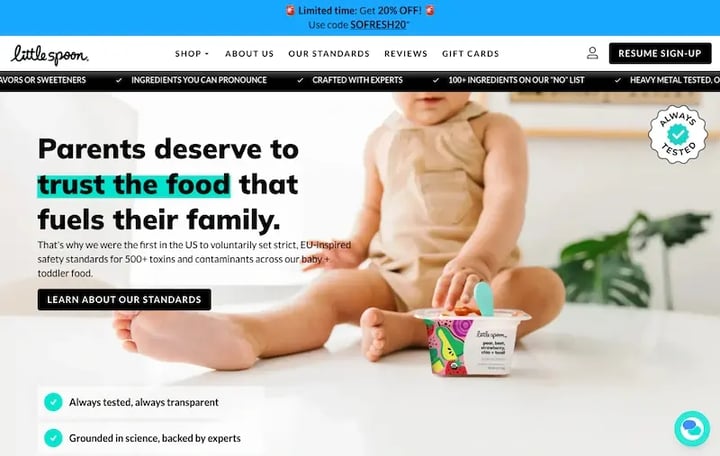
Check out what this looks like on the Little Spoon homepage.
This brand doesn’t just point out that it feeds over 500k families. It further incorporates trust signals into its online presence, with an entire website section dedicated to explaining ingredient standards, testing commitments, and third-party certificates. These trust badges reappear throughout the website — including product pages — ensuring shoppers always remember that Little Spoon is a brand they can rely on to deliver high-quality food without sacrificing safety or quality for a better profit margin.
Content Structured for Scanning, Not Just Reading
A common web user behavior that should inform your design decisions — particularly when aiming to create enjoyable user experiences that aid site performance — is that most people don’t read online.
According to over two decades of research conducted by the NN Group,
Around 80% of people scan web pages rather than reading them word-for-word.
What this means for web design is that enjoyable, easy-to-use resources need to be structured to allow scanning.
This doesn’t just optimize web performance in a way that aligns with what consumers want when interacting with brands. It also prevents web visitor frustration, elevates product understanding (via accessibility and readability), and eases movement through the sales funnel, shortening the time periods required for buyers to move from one stage of the buyer’s journey to the next.
What’s great is that elevating the scannability of your online presence doesn’t necessitate a complete web design overhaul.
In addition to optimizing web copy for readability, you can further accomplish this goal by incorporating relevant visuals into your pages or using formatting techniques that separate content blocks into easily digestible sections.
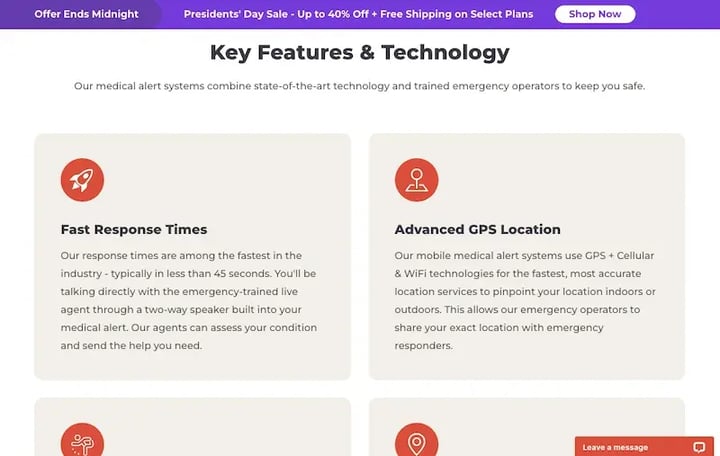
Check out how Bay Alarm Medical does this on its homepage.
This brand knows it sells a complex, innovative product. Yet its target audience consists of elderly users and their caretakers, whose expertise in digital alert devices may not be high. That’s why Bay Alarm does everything in its power to make its pages scannable:
-
Using typography to emphasize key product features.
-
Segmenting copy into feature-oriented chunks.
-
Supporting its claims with descriptive visuals, which effectively elevate product understanding.
This approach helps visitors quickly understand the benefits the business offers. Moreover, it prevents non-expert buyers from becoming overwhelmed by blocks of technical text that could cause them to stall in or completely abandon the sales funnel.
Consistency Across Pages That Builds Confidence
Lastly, as you explore opportunities to design high-performing digital experiences that guide your prospects toward conversion, don’t forget about the importance of consistency within your online presence. This doesn’t just pertain to branding consistency across various digital distribution channels. More importantly, it’s about the uniformity of your brand’s communication and approach to resolving customer pain points.
Ultimately, if you look at what breeds brand credibility, you’ll discover that cohesion often plays a significant role in allowing products (or brands) to appear established and reliable.
So, explore ways to make digital brand experiences as unified as possible — both visually and communicatively.
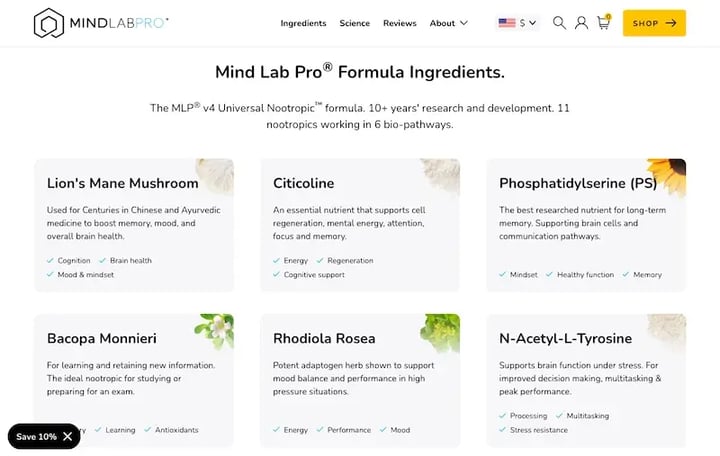
Mind Lab Pro does this beautifully.
This brand created a website design that is fully uniform in terms of design and color palettes. But, perhaps much more importantly, the digital experience it provides to web visitors is even more harmonious. All of the messaging and product details on the homepage aim to educate prospects about the potential benefits of nootropics in elevating cognitive function. The insistence on backing each claim with scientific data further establishes the brand’s credibility, removing consumers’ doubts and making shoppers feel at ease as they move through the sales funnel.
Final Thoughts
Acquiring new customers requires a strong commitment to creating enjoyable digital experiences. After all, with so many options available online, consumers will inevitably choose to buy from brands that make the buyer’s journey user-friendly, risk-free, and fully customer-centric.
What’s worth noting, however, is that the highest-performing brands consistently rely on specific aspects of CX to achieve their business goals.
So, whether you optimize your messaging to be purpose-driven, overhaul your web design to guide user attention, improve your navigation menus, or embed trust-building elements into your online presence, you’re sure to see positive outcomes. So, give these tips a try, and see how they serve you. You can draw inspiration from the examples listed in this guide, or you can adjust these tactics to your brand’s unique needs — you’re sure to see an improvement in your conversion rates either way.
Aspiration Marketing is here to help.