Turning Brand Credibility Into Revenue

In an age of deepfakes, AI-generated content, and endless data breaches, what is the most expensive commodity in business?
It isn’t data. It isn’t oil. It isn’t even attention.
It is the truth.
We are living through a “Trust Crisis.” Consumers are skeptical. False promises and hidden fees have left them burned. As a result, they have built high walls around their wallets. For modern decision-makers, trust is no longer just a warm, fuzzy feeling. It is a hard economic metric. It is the difference between a bounce and a conversion. It is the fuel for long-term growth.
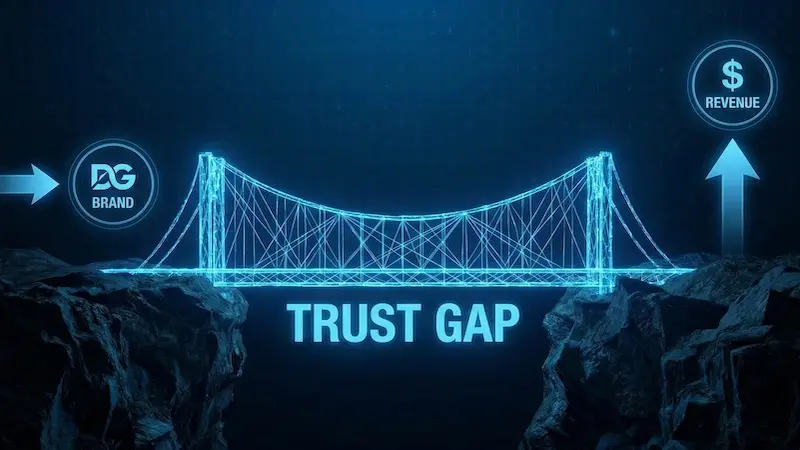
Yet, many companies still treat trust as a “nice-to-have.” They focus on flashy ads and aggressive sales tactics. They ignore the foundational work of brand credibility. This creates a dangerous “Brand Trust Gap“—the vast distance between what a brand says and what customers actually believe.
How do you bridge that gap? How do you prove you are one of the good guys?
Below, we’ll examine the measurable impact of trust on branding. We’ll examine the data, economics, and strategies you need to thrive. We will show you how to move from simply being “seen” to being “believed.”
The Economics of Trust: Why It’s a Revenue Driver
Let’s start with the money.
For a long time, branding was viewed as an art form. It was about colors, logos, and vibes. But today, branding is math. Specifically, it is the math of risk.
When a customer looks at your product or service, they are running a risk calculation. Will this work? Is this safe? Will I look foolish for buying this?
Trust lowers that risk. When risk decreases, sales increase.
The “Permission to Buy” Metric
You cannot close a sale if the door is locked. Trust is the key that opens that door.
Recent data paints a clear picture. According to 2025 statistics from Amra & Elma,
81% of consumers need to trust a brand before they even consider buying from it.
Think about that. If you lack credibility, four out of five people will likely ignore you. It doesn’t matter how good your product is. It doesn’t matter how low your price is. If they don’t trust you, you don’t have permission to sell to them.
Furthermore,
It is often a bigger factor than convenience or price. In the B2B world, where contracts are large and careers are on the line, this number is likely even higher.
The “Premium” of Credibility
Here is a question for you: Would you pay more for a promise you can keep?
The answer is yes. Credible brands have pricing power. When you are trusted, you do not have to compete in a race to the bottom.
Research from Salsify in 2025 indicates,
87% of shoppers are willing to pay more for products from brands they trust.
You are not just selling a widget; you are selling peace of mind.
Even when money is tight, values matter. PwC’s 2024 Voice of the Consumer survey found that:
Consumers are willing to pay an average of 9.7% more for goods that are sustainably sourced and trustworthy.
This is the ROI of credibility. It protects your margins. It secures your market share. It turns a commodity into a premium asset.
The Three Pillars of the “Role of Trust”
So, we know trust makes money. But what is it made of?
Trust is not magic. It is a structure. You can build it, brick by brick. To understand the role of trust, we need to break it down into three core pillars.
1. Competence and Consistency (The “Can You Do It?” Factor)
The first pillar is the most basic: Ability.
You can be the nicest company in the world. You can donate to charity and have a great mission statement. But if your product breaks, you lose.
Trust is built on competence. It is the assurance that you can do what you say you can do.
This extends to your digital presence. Your website is your handshake. If your site loads slowly, has broken links, or appears outdated, it signals incompetence.
We call these “B2B trust signals.” A broken contact form tells a prospect, “We don’t pay attention to details.” An outdated copyright date in your footer says, “We aren’t active anymore.”
2. Radical Transparency (The “Are You Hiding Something?” Factor)
The second pillar is openness.
In the past, businesses were often perceived as “black boxes.” You put money in, and a product came out. You didn’t know what happened inside.
Today, customers demand “glass boxes.” They want to see inside. They want to know about your values, sourcing, and data policies.
In the B2B space, hiding information is a red flag. Have you ever visited a software site that hides its pricing information? It feels like a trap. Brands that offer clear, tiered pricing transparency win faster. They show respect for the buyer’s time.
Data privacy is enormous here. PwC (2024) reports that:
83% of consumers say the protection of their personal data is the most crucial factor in earning their trust.
If you are not transparent about how you use data, you are building on sand.
3. Social Proof and Authority (The “Who Says So?” Factor)
The third pillar is validation.
We are social creatures. We look to others to see what is safe. In the past, we trusted ads. Now, we trust each other.
The shift is massive.
54% of consumers trust online reviews more than personal recommendations, according to Amra & Elma (2025).
This is why digital brand authority is so vital. You cannot just tell people you are great. You need others to say it for you.
This comes from:
-
Case studies.
-
Client testimonials.
-
User-generated content.
-
Influencer partnerships.
When a third party vouches for you, your credibility score skyrockets. It removes the bias. It proves that real people solve real problems with your help.
Closing the Brand Trust Gap: Strategic Actions
We have the theory. Now, let’s look at the practice.
How do you implement this? How do you close the “Brand Trust Gap” in your daily operations?
Here are three actionable strategies to make credibility a core part of your brand.
Data Protection as a Brand Asset
Stop treating security as an IT task. It is a marketing asset.
If you’ve gone through the hard work of getting SOC2 compliant or ISO certified, shout it from the rooftops. Put those badges on your homepage. Please put them in your email footer.
These badges are not just technical jargon. They are trust signals. They tell your customers, “We value your safety.”
Security breeds confidence. Confidence breeds sales. By highlighting your robust data strategies, you separate yourself from the risky options in the market. You can learn more about how to increase trust through credibility-building data-driven approaches.
The SEO Connection (Digital Authority)
Did you know that Google is a trust engine?
Google’s ranking system is based on a concept called E-E-A-T. This stands for Experience, Expertise, Authoritativeness, and Trustworthiness.
If you rank on Page 1, it is not just luck. It means the world’s biggest search engine has vetted you.
Consumers know this intuitively. They associate top rankings with industry leadership. If you are invisible on search, you seem risky. If you are visible, you seem credible.
Creating high-quality, helpful content builds this authority. It shows you know your stuff. It answers questions. It solves problems before you even ask for a sale.
For a deeper dive, check out the SEO guide to building a stronger digital brand. It explains how search visibility acts as a third-party endorsement of your power.
Humanizing the Brand
Finally, remember that people trust people. They do not trust logos.
One of the easiest ways to boost trust is to show your face. Who is behind the brand? Who are the experts?
-
Use real photos of your team, not stock photos.
-
Create detailed author bios for your blog posts.
-
Link to your team’s LinkedIn profiles.
When you humanize your brand, you become relatable. You become vulnerable. That vulnerability creates a connection.
You can read more about these tactics in our guide on trust strategies for credibility.
FAQ: Understanding the Role of Trust in Branding
We cover a wide range of topics when discussing trust. Here are 10 of the most frequently asked questions by decision-makers about the role of trust in their strategy.
1. Why is trust so important in branding right now?
Trust reduces friction. It lowers your Customer Acquisition Cost (CAC) because you spend less time and money convincing people you are legitimate. It also increases Lifetime Value (LTV). Trusted brands keep customers longer.
2. How do you actually measure brand trust?
You can’t put it on a scale, but you can track it. Look at your Net Promoter Score (NPS). Look at your churn rates. Analyze social media sentiment. High repeat purchase rates are also a strong sign of deep trust.
3. What exactly is the “Brand Trust Gap”? This is the difference between what you promise and what the customer experiences. If your marketing says “World Class Support” but your hold time is 40 minutes, you have a trust gap. Closing this gap is the primary goal of credible branding.
4. How does SEO impact brand trust? High organic visibility acts as a stamp of approval. When users see you at the top of search results, they assume you are a major player in the industry. It builds subconscious confidence in your brand.
5. Can trust be rebuilt if it is lost? Yes, but it is hard. It requires radical transparency. You must acknowledge the mistake, explain how you corrected it, and demonstrate consistency over time. It is much cheaper to keep trust than to rebuild it.
6. Is the role of trust different in B2B vs. B2C? The core emotion is the same, but the stakes are higher in B2B. A bad B2C purchase might cost $50. A bad B2B purchase could cost a job or a company’s reputation. Therefore, B2B trust requires more logical proof and data.
7. How does visual design affect credibility? Poor design is a trust killer. If your website looks like it was built in 2010, users assume your product is also outdated. Modern, clean design signals that you are active, professional, and attentive to detail.
8. Should I delete negative reviews to protect my brand? No. Never delete genuine reviews. A perfect 5-star rating often looks fake. Responding to a bad review with grace and a solution shows potential customers that you care about service, which builds more trust than a perfect score.
9. How do employees influence brand trust? Your employees are your ambassadors. If they are happy and speak well of the company, it validates your culture. If they are disgruntled, it leaks out. Treating your team well is a direct way to build external credibility.
10. What is the role of content marketing in building trust? Content allows you to help before you sell. By providing free, valuable answers to customer problems, you position yourself as a helpful expert. This establishes a relationship based on value, not just a transaction.
The Trust Foundation
Trust is the foundation of the modern buyer’s journey.
It is hard to earn. It is easy to lose. And most importantly, it is impossible to buy. You cannot pay for a reputation; you have to prove it.
As we move forward, the market will become increasingly noisy. AI will flood the internet with an increasing amount of content. The “human” element of trust will become the ultimate differentiator. The brands that win will be the ones that tell the truth, prove their competence, and treat their customers with respect.
But building this level of credibility requires more than just good intentions. It requires a plan. It requires data.
This is where Aspiration Marketing comes in.
We help businesses bridge the trust gap. We understand that credibility is a mix of art and science. Whether you need “Smart Marketing” services to refine your message, SEO strategies to build your digital authority, or a HubSpot implementation to ensure transparent data handling, we have the tools you need.
We do not just help you look good. We help you stand as a thought leader. We help you turn credibility into a growth engine.
Are you ready to close the gap between your promise and your performance?
Take the next step. Audit your own “Trust Gap” today. Check your digital signals. If you are ready to build a lasting brand, reach out to us. Let’s make something real, together.