Navigating the 2026 Shift to Answer Engine Optimization

When was the last time you scrolled to the bottom of a Google search results page? Better yet, when was the last time you even clicked a blue link to find a simple, factual answer? If you are like most internet users today, the answer is likely “not recently.” We have moved rapidly from an era of searching to an era of answering.
For over two decades, Search Engine Optimization (SEO) was the undisputed king of digital marketing. We obsessed over keywords, backlink profiles, and domain authority. But a new challenger has taken the throne: Answer Engine Optimization (AEO). While they share a common lineage, the AEO vs. SEO debate is not just about tactics. It is about a fundamental shift in how humans interact with the sum of all knowledge.
This shift represents a move from the Ten Blue Links model to a single, synthesized response. Whether it is through ChatGPT, Google’s AI Overviews, or specialized AI agents, the way people find your brand has changed. If your content is not built to be “read” by a machine and “spoken” to a user, you are essentially invisible.
The Data Behind the Shift: Why 2025/2026 was the Tipping Point
Why is everyone talking about AEO vs SEO right now? Because the numbers are finally catching up to the hype. We are no longer speculating about a future with AI; we are living in a world where AI is the primary interface for information.
To truly understand this transition, we have to look at the primary shift in the searcher’s intent. In the past, people searched to find a list of sources. Today, they search to find a definitive answer.
This isn’t just a trend; it’s a structural evolution of the internet. Here is a breakdown of why this is the conversation of the year and who is leading the charge.
Why the Buzz? The “Clickless” Reality
The reason every marketing department is pivoting to AEO is that the traditional search result is becoming a secondary feature. Gartner recently predicted,
2025/2026 search engine volume dropped by 25% as users migrate to AI chatbots.
When an AI engine like Perplexity or Google Gemini gives a full, 300-word answer, the user has no reason to click through to your blog. This has created a Retrieval Gap. If you aren’t optimized for the answer engine to retrieve your data, you don’t just lose rank—you lose existence in the user’s journey.
Furthermore, the click itself is becoming a rare commodity.
Recent data suggests that 60% of searches now end without a single click.
These zero-click searches happen because the AI provides the answer right on the results page.
For businesses that rely on website traffic to fuel their leads, this is a wake-up call.
When an AI Overview is present,
The organic click-through rate (CTR) for traditional links can plummet by as much as 61%.
Despite this, the opportunity is massive. ChatGPT alone now processes over 2 billion queries every single day. The question for marketers in 2026 is no longer “How do I rank #1?“ but rather “How do I become the source that the AI cites?”
Reputable Sources & Thought Leaders
If you’re looking for a deep dive into the data, several industry giants have released definitive reports on this shift for 2026:
-
Conductor (The 2026 AEO Benchmarks Report): Pat Reinhart, VP of Thought Leadership at Conductor, is one of the most vocal advocates for shifting KPIs from Clicks to Citations. Their recent data shows that while AI referral traffic is currently small (around 1-2%), it is growing by roughly 1% every month.
-
seoClarity: They’ve highlighted the shift toward “High-Density Content.” In 2026, users aren’t searching for “best mountain bike“; they are asking for “lightweight carbon-fiber mountain bike under 25 lbs with hydraulic disc brakes for a 5’10” rider.” Traditional SEO can’t handle that level of specificity, but AEO can.
-
Acquia: Their survey found that 70% of marketers believed AEO would significantly impact their strategy in 2026, yet only 20% have actually started implementing it.
Understanding the AEO vs SEO Differences
To succeed today, you must understand how these two disciplines differ in their discovery mechanisms.
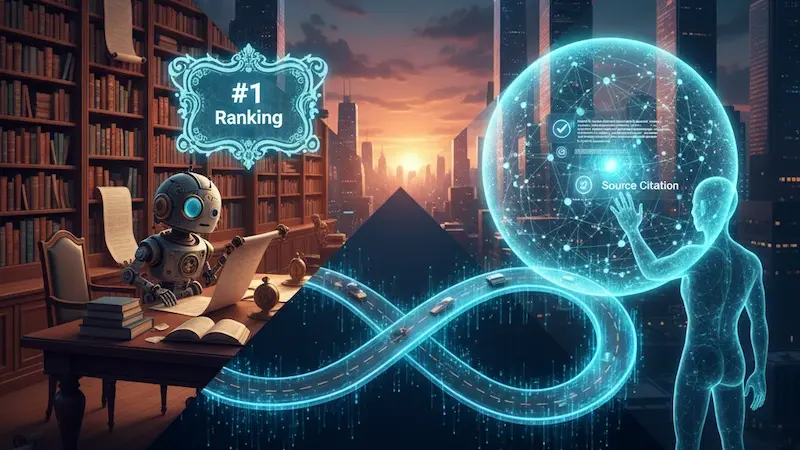
Traditional SEO is built for crawlers. Think of Googlebot as a very diligent librarian who looks at the index of every book, checks who else has cited that book (backlinks), and decides which book should be on the top shelf. SEO is about being the best book on the shelf.

AEO, on the other hand, is built for Large Language Models (LLMs). These models don’t just point to the book; they read it, summarize the key points, and give the user the answer in a conversational tone. While SEO focuses on rankings and clicks, AEO focuses on citations and direct extraction.
Content Structure: Snackable vs. Comprehensive
In traditional SEO, long-form has been the gold standard. To rank for a competitive keyword, you often need a pillar page that is 2,300 words or more. You need to cover every possible angle of a topic to prove your authority to the search engine.
AEO requires a different approach. While depth still matters for credibility, the AI-ready portion of your content needs to be snackable. LLMs look for clear, concise, and structured data. If you want to win at the AEO vs SEO game, you need to provide answer blocks. These are sections of 40 to 60 words that directly answer a specific question.
Imagine a user asking, “What are the benefits of AI in marketing?” An SEO-focused page might bury that answer on page four of a whitepaper. An AEO-focused page will have a clear heading followed by a direct, three-sentence summary that an AI can easily scrape and credit.
Ranking vs. Citation
This is perhaps the biggest shift in mindset. In SEO, the goal is Position 1. In AEO, the goal is to be the Source Citation.
If a user asks an AI agent a complex question, the AI will synthesize an answer from three or four top-tier sources. Being one of those four sources is the new Position 1. You may get fewer clicks than you did in 2022, but the clicks you do get will be from users who have already seen your brand cited as an expert. This creates a much higher level of trust before the user even lands on your site.
The New Metrics: Tracking Success in a Zero-Click World
If people aren’t clicking as much, how do we measure marketing success? We have to move beyond traditional traffic metrics. In 2026, Total Sessions is a lagging indicator.
We are seeing the rise of Citation Tracking. Digital marketers are now using tools to see how often their brand name appears in AI-generated footnotes. If ChatGPT mentions your brand as a leader in “loop marketing,” that is a win, regardless of whether the user clicked the link in that specific session.
Another vital metric is Share of Model (SoM). Just as we used to track “Share of Voice” in traditional media, SoM measures how often an LLM associates your brand with specific keywords or categories compared to your competitors.
Interestingly, while total clicks might be down, the quality of the remaining clicks is often higher.
Brands that appear in AI Overviews actually see a 35% higher organic CTR on their links than those that appear in traditional results but are ignored by the AI.
This suggests that being “blessed” by the AI as a credible source acts as a powerful endorsement.
How to Build an AEO-Ready Foundation
So, how do you actually optimize for this new world? It starts with technical clarity.
Schema Markup: The Language of Machines
If your website were a house, Schema markup would be the blueprint that tells the AI exactly where the kitchen is and how many bedrooms there are. In the AEO vs SEO landscape, Schema is your most powerful tool. By using FAQ, HowTo, and Organization schema, you are essentially translating your human-readable content into a format that AI agents can digest without any ambiguity.
The “Answer-First” Content Model
We recommend a hybrid approach to content creation. Every piece of content should follow an answer-first model.
-
Step 1: Start with a clear, direct answer to the primary question (AEO focus).
-
Step 2: Follow up with a comprehensive, deep-dive analysis (SEO focus).
-
Step 3: Use bullet points and numbered lists to highlight key data.
This structure satisfies both the AI bot looking for a quick snippet and the human reader looking for a detailed guide.
Doubling Down on E-E-A-T
Experience, Expertise, Authoritativeness, and Trustworthiness (E-E-A-T) have never been more important. Why? Because AI can synthesize facts, but it cannot synthesize genuine human experience.
AI models are trained to prioritize sources that show real-world expertise. To stand out, your content should include original research, personal case studies, and unique insights that a machine cannot simply “hallucinate” or scrape from a generic site. In 2026, being an authority is your best defense against being replaced by an AI summary.
Conversational Keyword Research
The way we research keywords has to change. We are moving away from short, choppy phrases like “AEO vs SEO differences” and toward natural language questions like “What was the difference between AEO and SEO in 2026?“
People talk to their AI assistants like they talk to a friend. Your keyword strategy should reflect that. Use tools to find the “long-tail” questions your customers are actually asking. If you can answer the “Why” and the “How,” you are much more likely to be the primary citation for an answer engine.
AEO in Action: Real-World Scenarios
Let’s look at how this shift plays out in the real world.
Embracing the Hybrid Future
Following 2026, it became clear that the AEO vs. SEO debate is a false dichotomy. You do not have to choose one. In fact, you cannot have a successful AEO strategy without the technical foundation of a strong SEO program.
SEO ensures that your site is fast, mobile-friendly, and crawlable. It builds the “bones” of your digital presence. AEO then adds the “voice.” It ensures that your content is formatted to be helpful, direct, and authoritative in a world where users expect instant gratification.
The goal isn’t just to be found on page one. The goal is to be the definitive answer that the world’s most powerful AI models rely on.
Partnering for the Next Phase of Growth
Navigating this transition requires a partner who understands the nuances of the AEO-enabled marketing ecosystem. At Aspiration Marketing, we specialize in helping brands evolve their strategy to meet the demands of a changing search landscape. From the initial stages of awareness to the final stages of the buyer’s journey, we ensure your message is heard—by both humans and machines.
Whether you are trying to understand the latest HubSpot AI features or looking to deploy autonomous AI agents to handle customer queries, the key is to stay ahead of the curve. The shift to AEO is a massive opportunity for those who are willing to adapt.
Are you ready to see how your brand performs in the age of answer engines? We can help you audit your current visibility and build a content strategy that doesn’t just rank, but answers.