How AI is Changing SEO — What Content Marketers Need to Know to Adapt


Content marketers spent years perfecting their SEO strategies and quickly responding to every Google search algorithm update. But now, in the age of AI, SEO is fast being eclipsed by GEO and AEO.
Artificial intelligence is reshaping how people search for, consume, and trust information online. Content marketers need to expand their knowledge and skills to remain effective as AI-driven search accelerates.
Does this mean SEO is dead? No, but you need to know how it fits into the AI landscape. This article will help you understand how AI is changing SEO, and how you can adjust your content marketing strategy to produce content relevant to all search platforms.
How AI is Reshaping Search Behaviour
In the past, search engine optimization (SEO) was primarily keyword-driven. Today, AI-powered algorithms and large language models (LLMs) prioritise user intent, context, and semantic meaning over exact keyword matching.
This has led to a rise in conversational, problem-based, and long-tail searches. AI is impacting everything from how search engines rank content to how users interact with it.
Generative AI Platforms Are Being Used as Search Engines
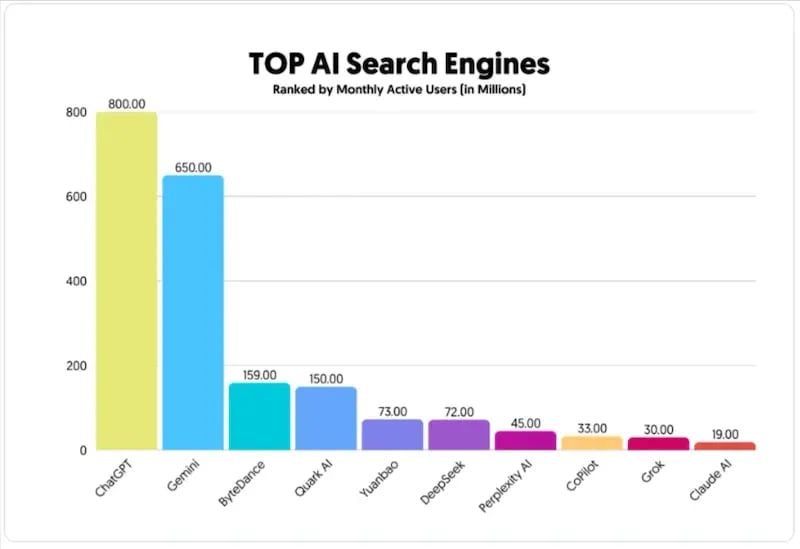
More people are using generative AI platforms as search engines. ReliableSoft analysed publicly available monthly active user data and found that 800 million users used ChatGPT as a search engine. Google’s Gemini followed with 650 million monthly users, and ByteDance’s Douyin with 159 million users.
For these platforms to find and reference your content in their responses, keywords alone are no longer enough. AI search algorithms focus less on matching individual terms and more on understanding the intent and meaning behind each query.
This does not mean keywords no longer matter. Rather, it means content must also deliver clear context, comprehensive answers, and genuine value for the user. This shift requires deeper audience research and more strategically structured content.
Search Engines Provide Detailed Answers to Queries
You may have noticed that Google now has an AI overview at the top of the search page, which immediately provides a detailed answer to your search query.
To provide this overview, Google pulls information from multiple sources, prioritizing content that demonstrates the following:
The Future of Search Optimization: GEO and AEO
Two new buzzwords have entered the cybersphere: generative engine optimization (GEO) and answer engine optimization (AEO). What do these terms mean, and how do they differ from SEO? Let’s find out.
What is Generative Engine Optimization (GEO)
Generative engine optimization (GEO) focuses on optimising content for AI-driven search, such as ChatGPT, Perplexity, and Google’s AI Overviews, so they can accurately find, interpret, summarize, and reference it in their responses.
The key difference between SEO and GEO lies in how information is retrieved and presented. Generative engines do not simply list links in their replies. They interpret information from multiple sources to generate a single, cohesive answer.
SEO is largely about earning clicks that drive traffic directly to your website, while GEO centres on visibility within AI-generated responses. The more frequently your brand appears in AI answers or citations, the more familiar and credible it becomes to users, increasing the likelihood they will explore your content or services further.
As a result, content is evaluated less on its ability to rank for a specific keyword and more on whether it clearly explains a topic, provides reliable context, and aligns with how LLMs understand that subject area.
With GEO, content marketers need to think beyond traffic and rankings. Your goal is not just to be found, but to build authoritative, well-structured content that AI systems can confidently interpret and trust as a reliable source. These tools increasingly act as intermediaries between brands and their customers.
What is Answer Engine Optimisation (AEO)
Answer engine optimization (AEO) focuses on structuring content to deliver clear, direct answers to user questions across search engines and AI-powered platforms. While it is often mentioned alongside GEO, it is not the same thing.
AEO focuses on how content answers specific questions, whereas GEO focuses on how generative AI systems interpret and reuse content to produce broader responses.
In the past, the goal of SEO was to rank pages highly in search results so users would click through to your website. Success was measured in incoming traffic volumes, how long visitors stayed, and how many pages they viewed. Even when Google showed a short snippet, the user may still visit your site to get the full answer.

AEO is about creating answers to help search engines and AI platforms answer questions directly on the results page or within the interface. That means the user may never click through to your website.
In these cases, your content is used and credited, but the interaction might end with the answer, with no click-through to your website.
How you measure the success of your AEO content marketing isn’t by counting the number of users who flow through to your site. Instead, you’ll look at whether your content was:
Why This Matters for Content Marketers
If content is not written clearly enough for AI-powered search engines to extract a direct answer, it may not surface, even if it ranks well in traditional SEO results.
AEO requires content that is highly structured with answers that are cleanly, directly, and authoritatively framed. Headings, frequently asked questions, and short explanatory sections all make it easier for search engines to quickly extract relevant information. This is one reason many blogs are adding an FAQs section at the end of blog articles.
SEO as Part of an Integrated Content And Business Growth Strategy
AI is pushing SEO beyond its traditional role towards what is increasingly described as “search everywhere optimisation”. This expanded role has implications for both content planning and broader business growth strategies.
If you’re not showing up where your customers are actively looking for answers, you risk losing visibility and relevance to competitors who are. Realistically, it is not possible to rank at the top of every search enquiry, but you can strengthen your content marketing approach to improve your brand’s visibility.
SEO still has a role to play in helping AI search engines discover, understand, and reference your content. SEO insights can inform everything from content creation and social media to inbound campaigns and sales enablement. It should be viewed as a connective layer across your content ecosystem, rather than a standalone channel focused purely on rankings.
Research by ZipTie analyzing 25,000 user searches found that the websites that ranked at the top of the Google page results appeared in AI-generated search answers 25% of the time.
As you transition to an AI-powered marketing landscape, some decline in click-through traffic is to be expected. While this can be alarming for content marketers, remember that direct traffic alone is no longer the main measure of success. Your goal is to build authoritative content that earns visibility, trust, and influence wherever answers are being delivered. This positions your brand as credible and trustworthy, which carries tremendous weight with customers.
How Content Marketers Are Adapting to AI-Driven Marketing
Adapting to an AI-driven marketing environment is more than experimenting with new tools. It requires a two-pronged approach: building AI literacy across your digital marketing team, and rethinking how content is planned, created, and measured.
Acquiring AI Marketing Skills
Trying to “figure it out” on your own is rarely effective in an environment this complex. Content teams need a stronger foundation in how AI systems work and how they intersect with marketing and communications.
This may involve short training courses on how specific tools or platforms work. For digital marketing leaders, this shift often requires more structured learning. Formal study in areas such as strategic communication and digital strategy can help marketers better understand how AI-driven systems interpret content, establish credibility at scale, and translate performance metrics into long-term business impact.
Closer collaboration with sales and leadership teams is also essential to ensure content performance is aligned with business growth outcomes.
Adjusting Your Content Strategy For AI-Search Discovery
Alongside skills development, content strategies themselves need to shift to meet the demands of AI answer engines.
Here’s what you can do to better position your content for AI-driven search.
Building a Stronger AI Content Marketing Strategy in 2026
The rapid rise of AI-powered search caught many content marketers off guard in 2025. Now that there’s a better understanding of how generative and answer engines discover, interpret, and surface content, the focus is shifting from a reactive to a proactive strategy.
It’s easy to become distracted by all the AI noise. Rather, prioritize building content that is authoritative, well-structured, and genuinely useful. This is the type of content that is more likely to be trusted, selected, and referenced by AI-driven search engines, bringing your brand to a wider audience.
Aspiration Marketing is here to help.