ERP vs. CRM – What is the Difference and Which Do I Need?

Are you navigating the challenge of rapid business growth? If you are, you know that relying on scattered spreadsheets and siloed data simply cannot keep pace with your ambitions. You need a system that can scale.
When leaders in the software and technology space talk about scaling technology, two acronyms dominate the conversation: ERP and CRM.
It is common to confuse these terms. Many business leaders mistakenly view Enterprise Resource Planning (ERP) and Customer Relationship Management (CRM) as interchangeable tools—or, worse, as competing software that forces a difficult choice. However, misunderstanding their distinct functions or prioritizing the wrong one first can easily create operational bottlenecks and stall growth.
This guide will eliminate the confusion. We define the fundamental differences between ERP vs. CRM, explore the distinct strategic advantages each offers, and provide a clear, data-backed roadmap. By the end, you will know precisely which system your business needs to prioritize right now for maximum impact.
I. Decoding the Acronyms: Front Office vs. Back Office
To understand the difference, you must first clarify their core purpose. Think of your business operations as a restaurant: the CRM is the smiling face and host at the front door; the ERP is the complex cooking and inventory system in the kitchen.
What is Customer Relationship Management (CRM)? (The Front Office Focus)
A CRM is a system specifically designed to manage every interaction and relationship with customers and potential customers. It is your company’s intelligence hub for the entire customer journey, from first touchpoint to loyal advocate.
The core purpose of a CRM is straightforward: to improve customer relationships, streamline sales processes, and enhance marketing efforts. It focuses on maximizing customer lifetime value (CLV).
Key Functions and Examples:
-
Contact and Lead Management: Organizes all prospect information, ensuring your team has a full customer history.
-
Sales Pipeline Tracking and Forecasting: Moves deals through defined stages, giving leadership accurate sales predictions.
-
Customer Service and Support: Manages service tickets and communication logs to ensure quick, satisfying resolutions.
-
Marketing Automation: Runs personalized email campaigns and tracks audience engagement.
The data a CRM focuses on is external-facing and relational: customer profiles, communication history, purchase patterns, and lead scoring. Simply put, the CRM is your “Sales Floor” – the place where you build relationships, close deals, and manage the customer experience.
What is Enterprise Resource Planning (ERP)? (The Back Office Focus)
An ERP system is an integrated software suite used to manage and seamlessly connect the core business processes of a company across various departments.
The core purpose of an ERP is internal: to increase operational efficiency, reduce costs, and ensure compliance. It achieves this by creating a single, unified source of data for the entire organization—a concept often referred to as the “single source of truth.” It focuses on optimizing the use of business assets.
Key Functions and Examples:
-
Financial Management: Handles the general ledger, accounts payable and receivable, and financial reporting.
-
Inventory and Warehouse Management: Tracks stock levels, locations, and material requirements in real time.
-
Supply Chain and Procurement: Automates purchasing, manages vendor relationships, and optimizes logistics.
-
Human Resources (HR): Manages payroll, employee data, and talent acquisition.
The data an ERP focuses on is internal, operational, and transactional: costs, inventory levels, order history, and production capacity. The ERP is your “Engine Room”—the complex, central mechanism that keeps all operational processes running efficiently.
II. The Strategic Divide: Customers vs. Resources
While both systems are vital data repositories, their primary functions are distinct. They exist at opposite ends of the business workflow, and this difference defines their strategic role.
The Fundamental Divide in Focus
The most significant distinction is where they focus their efforts and what metrics they prioritize:
- CRM’s Metrics: Sales velocity, lead conversion, and customer retention.
- ERP’s Metrics: Operational cost reduction, production efficiency, and financial accuracy.
Data Ownership and Flow
CRM and ERP also manage different types of data, and the flow is critical:
-
CRM Data Flow: Customer data starts with an external touchpoint (a website visit, a form submission, a sales call). It tracks fluid, often qualitative information about the relationship, moving the customer from prospect to closed deal.
-
ERP Data Flow: Financial and inventory data is transactional, tracking tangible assets and financial movements—the purchase order, the precise inventory count, the vendor invoice. This information is quantitative and compliance-focused.
The CRM knows who bought what and how they like to be engaged. The ERP knows how much that what cost to make, where it is currently stored, and when the company needs to reorder the raw materials.
Primary Users and Daily Impact
The people who rely on each system also highlight the difference in focus:
.webp?width=800&height=688&name=ERP%20vs%20CRM%20chart%20(1).webp)
III. The Data-Driven Power of Each System
The value of an enterprise system is not in its complexity but in the measurable results it delivers. The statistics clearly show that both CRM and ERP investments produce significant and separate returns for businesses.

CRM’s Impact on Revenue and Customer Loyalty
A CRM converts scattered customer activity into focused, actionable intelligence, directly impacting the revenue stream and strengthening customer loyalty. This is the power of being customer-centric.
-
Revenue Return is Strong: A well-implemented CRM offers an exceptional return.
For every dollar a company spends on CRM implementation, the average return on investment (ROI) is a massive $8.71.
You do not speculate; you track results directly.
-
Boosting Productivity and Sales: Your team is currently spending time on administrative tasks instead of engaging with prospects. CRM changes that. Businesses that leverage CRM software can increase sales productivity by up to 34% and boost overall sales revenue by up to 29%. This means your team spends less time on administrative tasks and more time closing deals.
-
Conversion Rate Power: When sales teams use CRM tools to manage leads effectively, they gain clarity. This focus can lead to a 300% increase in lead conversion rates. Imagine tripling your conversions simply by organizing your process and following up strategically.
ERP’s Impact on Efficiency and Cost Reduction
An ERP system streamlines the entire internal business engine. By eliminating manual tasks and redundant data entry across departments, the ERP enables a leaner and more efficient operation.
-
Clear Productivity Gains: The efficiency is measurable.
Following ERP implementation, approximately 74% of businesses report increased productivity and improved operational efficiency.
You can do more with the same resources.
-
Stronger Cost Management: Real-time visibility stops capital waste. Roughly 62% of companies report reduced operational costs after adopting an ERP system, particularly in areas like purchasing and inventory control. This is the difference between knowing exactly what stock you have and guessing.
-
Breaking Down Silos: The ERP acts as the “single source of truth.” This benefit is felt across the organization, with 77% of companies reporting that an ERP system helped them break down previous data silos. This integration enables faster and more accurate strategic decision-making by providing everyone with access to the same, verified financial and operational data.
IV. Choosing Your Essential Tool: Which System Do You Need Now?
The decision of which system to implement first depends entirely on the most urgent bottleneck in your current business process. It is a strategic question, not a technical one.
When a CRM is the Clear Starting Point
A CRM should be your priority when your external, customer-facing processes are creating the most chaos. This is especially true for service-based businesses, software companies, or any organization whose primary asset is their customer relationships, not their physical inventory.
Signs that you need a CRM first:
-
Sales Process: Your sales reps are using scattered spreadsheets, missing critical follow-up opportunities, or failing to track lead movement accurately.
-
Marketing Inefficiency: Your marketing efforts lack personalization, and you struggle to accurately attribute revenue to specific campaigns.
-
Customer Experience: Your customer service teams lack a quick, consolidated view of a client’s entire purchase and communication history.
When an ERP Becomes Non-Negotiable
An ERP becomes the urgent priority when your internal operational complexity is actively costing you money and overwhelming your ability to deliver products or services profitably. This is common for manufacturing, logistics, or high-volume product companies.
Signs that you need ERP first (or urgently):
-
Logistics and Inventory: You deal with significant inventory, complex multi-site warehousing, or critical supply chain logistics.
-
Financial Strain: Your financial close takes more than a week, or your team spends excessive time reconciling conflicting data from multiple sources.
-
Scaling Challenges: You are growing rapidly and must consolidate multi-entity, multi-currency financial reporting.
The Ultimate Solution: Integration is the True Goal
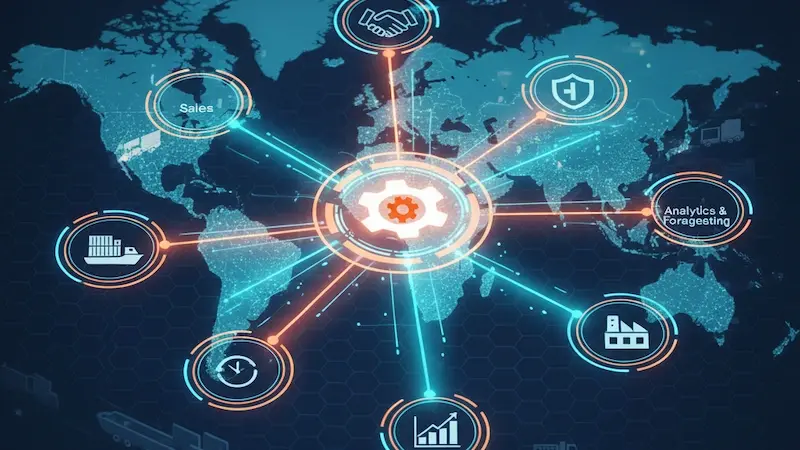
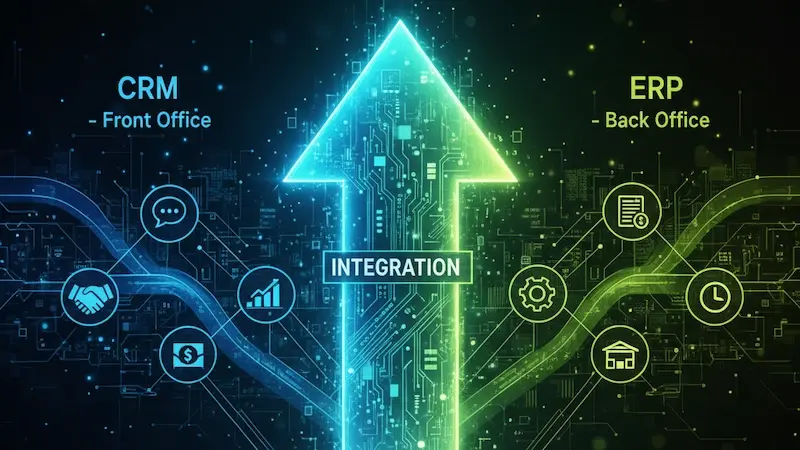
In modern, scaling businesses, ERP vs. CRM is a false choice. The question is not which one to use, but how to use them together. The true competitive advantage comes from connecting these two powerful systems.
The Power of Synergy: Integrating your CRM and ERP systems—connecting the front office to the back office—creates a powerful engine for growth.
-
Connecting ERP data (real-time inventory, order fulfillment status) with CRM data (customer profiles and sales history) empowers your sales and service teams.
-
Your sales rep can instantly see if an item is in stock while talking to a customer. This improves the buyer’s experience.
-
Your accounting team gets instant customer context for invoicing and collections, simplifying the billing process.
This seamless connection creates an unparalleled, profitable customer experience. The result is higher satisfaction and better internal controls.
V. A Strategic Path to Business Synergy
We have established that CRM focuses on maximizing customer value, while ERP focuses on optimizing internal resource value. Both systems are essential pillars of a scaling organization. Your strategic business needs must dictate which one you prioritize.
Understanding the ERP v. CRM dynamic is only the first step. The real challenge—and where the true ROI is realized—is in selecting the right-fit platform, customizing it to your specific workflows, and ensuring organization-wide adoption to capture those powerful metrics.
Ready to move past the ambiguity of “which one” and start deploying the strategic software that drives your next stage of growth?
This is where expert guidance is crucial. Work with Aspiration Marketing to define your strategic software roadmap. We help you select the best-fit platforms, implement them effectively, and seamlessly integrate your front and back offices. We empower your business to achieve unparalleled efficiency and predictable revenue growth.