Automating the MQL to SQL Handoff


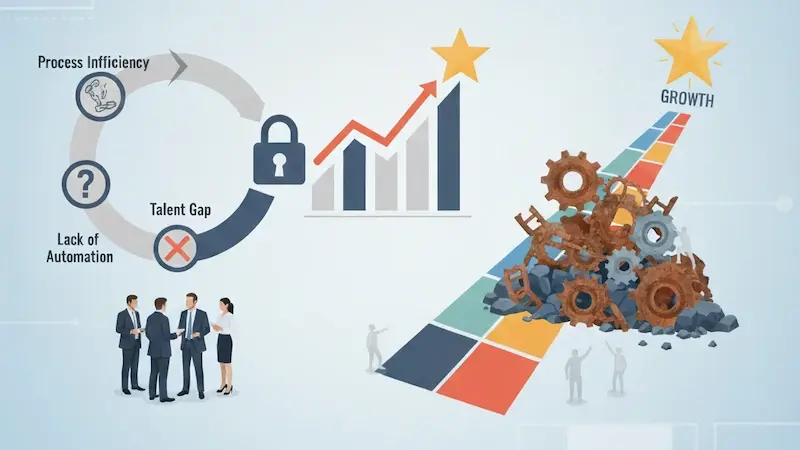
How many “hot” leads are currently sitting in your CRM, slowly cooling off because nobody claimed them? It is a question that keeps RevOps managers up at night. You spend thousands of dollars on targeted ads, hours on high-value whitepapers, and weeks on SEO. Then, a lead finally fills out a form. They are interested. They are ready. But instead of a swift introduction to a sales rep, they enter the “Messy Middle.”
The Messy Middle is that awkward, undefined space between a Marketing Qualified Lead (MQL) and a Sales Qualified Lead (SQL). It is where data goes to die, where sales reps complain about “junk leads,” and where marketing teams wonder why their hard-earned conversions aren’t turning into closed deals. In many organizations, this handoff is handled by spreadsheets, manual Slack messages, or, worst of all, “gut feelings.”
The cost of this friction is staggering. According to data from LeanData,
Roughly 25% of leads are routed to the wrong account owner, and 56% of companies take more than 24 hours to respond to a lead.
In a world where buyers expect instant gratification, a 24-hour delay is an eternity. If you want to build a predictable revenue engine, you have to move past manual processes and maintain your CRM data hygiene. You need a technical, automated, and data-driven lead handoff process.
The Architecture of a Modern Lead Handoff Process
Before we can automate anything, we have to define exactly what we are moving. You cannot automate chaos. A common mistake is assuming that everyone in the building agrees on what a good lead looks like. In reality, marketing often defines a lead by interest, while sales defines a lead by budget.
To bridge this gap, we need to look at the three specific milestones of the buyer’s journey:
-
Marketing Qualified Lead (MQL): A lead who has shown sufficient interest and fits the right profile to warrant further attention. They aren’t necessarily ready to buy, but they are “qualified” to receive marketing’s best efforts.
-
Sales Accepted Lead (SAL): This is the crucial, often-missed “handshake.” It is the moment sales looks at the MQL and says, “Yes, this meets our criteria. I will take it from here.”
-
Sales Qualified Lead (SQL): This is when a salesperson has had a discovery call and confirmed that there is a real opportunity, a timeline, and a budget.
Why does this matter so much? Because alignment is profitable. Research from the Aberdeen Group found that,
Highly aligned organizations achieve 32% year-over-year revenue growth, while their less aligned peers saw a 7% decrease.
When the lead handoff process is automated, it removes the subjectivity that causes friction between these two teams.
Technical Deep Dive: Advanced Lead Scoring Models
If the handoff is the engine, lead scoring is the fuel. You cannot treat a lead who downloaded a Top 10 Trends infographic the same way you treat someone who spent ten minutes on your pricing page. Automation allows you to weigh these actions differently using a two-factor authentication model for leads: Fit and Interest.
1. The Fit Score (Firmographics)
This is about who the person is. Does their company have the right revenue? Are they in the right industry? Is their job title “Director” or “Intern”? By using tools like HubSpot or Salesforce, you can automatically assign points based on these demographic details. If your ideal customer is a CEO of a mid-sized tech firm, they get 50 points immediately.
2. The Interest Score (Behavioral)
This is about what the person does. This is where you separate the “looky-loos” from the buyers. High-intent actions, such as requesting a demo or visiting a “Contact Us” page, should trigger immediate score spikes. Conversely, clicking on an email link might only add 2 points.
Avoiding “Score Bloat”
One of the biggest mistakes in RevOps is letting scores go up without any decline. If a lead was very active six months ago but hasn’t visited your site since, are they still a hot lead? Probably not. Technical leaders use score decay or negative scoring. If a lead visits your “Careers” page, they might be a job seeker rather than a buyer. You should automatically subtract points for that behavior. This ensures that when a lead finally hits the MQL threshold, they are genuinely ready for a conversation.
Automating the Route: Logic Over Luck
Once a lead hits the magic score and becomes an MQL, where do they go? If your answer is “to a general inbox,” you are losing money. Traditional “Round Robin” routing—where leads are simply handed out in a circle—is often too simple for complex B2B sales.
Intelligent routing uses automation to send the lead to the best possible person for the job. This might be based on:
-
Territory: Sending the lead to the rep who handles the Northeast region.
-
Account-Based Matching: If a lead comes in from a client company, the system should skip the SDR and go straight to the Account Manager.
-
Expertise: If the lead is from a healthcare company, it should go to the rep who specializes in healthcare.
The reason speed is so critical here is the Speed-to-Lead factor.
Responding to a lead within 5 minutes makes you 21 times more likely to qualify them compared to waiting just 30 minutes.
Automation makes this 5-minute window possible. By setting up workflows that trigger instant Slack notifications or SMS alerts to sales reps the moment a lead is routed, you ensure the buyer’s momentum isn’t lost.
The “Hard” Side of RevOps: Service Level Agreements (SLAs)
You can have the best software in the world, but if your humans don’t follow the rules, the system fails. This is where the Service Level Agreement (SLA) comes in. An SLA is a formal contract between marketing and sales. It defines exactly what each team is responsible for.

A typical RevOps SLA should cover three main pillars:
-
Time to Initial Action: How quickly must sales reach out? For high-intent leads (like a demo request), the SLA might be 2 hours. For a webinar attendee, it might be 24 hours.
-
Persistence: How many times will sales try to reach the lead? Too many reps give up after one or two phone calls. An automated system can track this and “recycle” the lead back to marketing if the rep doesn’t meet the persistence minimum (usually 6 to 8 touches).
-
Feedback Loops: This is the most crucial part. If a sales rep rejects an MQL, they must provide a reason. Was the budget too low? Was the timing wrong? Was it a competitor? This data is fed back into the lead scoring model to make it smarter.
Ask yourself: If your sales team isn’t required to log why a lead failed, how can your marketing team ever improve their targeting? Without this feedback, you are just throwing spaghetti at the wall.
Overcoming Tech Stack Friction
We often talk about “Sales vs. Marketing,” but the real war is usually “Tool vs. Tool.” When your marketing team lives in HubSpot, and your sales team lives in Salesforce, data can get lost during sync. A “Messy Middle” is often caused by technical debt—old workflows, duplicate records, and misaligned fields.
This is why a RevOps audit is essential. You need to review your tech stack and ask whether it is slowing you down. Are your integrations working in real-time? Is your data being enriched automatically?
Manual data entry is a lead killer. If a sales rep has to spend 10 minutes googling a company’s size before they make a call, you’ve lost the Speed to Lead advantage. Using automation tools to enrich data—filling in missing phone numbers, LinkedIn profiles, and company revenue—empowers your sales team to act fast.
The cost of ignoring your data health is high.
Bad data costs U.S. businesses roughly $3.1 trillion annually.
If your lead-handoff process is built on messy data, your automation will simply move bad leads faster.
Monitoring Success: The Metrics That Matter
To know if your new automated handoff is working, you have to look beyond just the number of leads. You need to track the transition’s efficiency. Key Performance Indicators (KPIs) for the Messy Middle include:
-
MQL-to-SQL Conversion Rate: If this number is low, your lead scoring is likely too “easy.” You are sending over leads that aren’t ready.
-
Average Lead Response Time: Are your reps hitting the 5-minute mark? If not, where is the bottleneck?
-
SDR Acceptance Rate: What percentage of MQLs are being accepted by the sales team? If they are rejecting 50% of your leads, there is a fundamental disconnect in your definitions.
-
Pipeline Contribution: Ultimately, how much revenue did these automated handoffs create?
By tracking these metrics, RevOps leaders can turn the Messy Middle into a transparent, measurable funnel. You can see exactly where a lead gets stuck and apply a technical fix rather than just pointing fingers.
The Human Element of Automation
It sounds like a contradiction, but the goal of automation is to make your brand feel more human. When a lead gets a fast, relevant response from a rep who already knows their pain points (thanks to enriched data and behavioral tracking), the experience feels personal. It feels like you are paying attention.
Compare that to the alternative: A lead fills out a form, hears nothing for three days, and then gets a generic “Are you still interested?” email from a rep who has no idea which pages the lead visited. The second experience feels like a transaction. The first feels like a partnership.
Why RevOps is the Key
The “Messy Middle” exists because marketing and sales are traditionally managed in silos. Marketing cares about “leads,” and sales cares about “deals.” RevOps is the glue that binds them together.
RevOps doesn’t take sides. It looks at the entire revenue cycle as a single process. By taking ownership of the lead handoff process, RevOps ensures that the technology, the data, and the people are all moving in the same direction. It turns the handoff from a “toss over the wall” into a seamless relay race.
Building Your Action Plan
If you are ready to solve the Messy Middle, start with these three steps:
-
Audit the Sync: Check your CRM and Marketing Automation platform. Are leads flowing through in seconds, or is there a delay? Is every field mapping correctly?
-
Interview Your Sales Reps: Ask them, “What is the one thing that makes you ignore an MQL?” Their answers will tell you precisely what needs to be added to your lead scoring model.
-
Standardize the Feedback: Create a mandatory “Lead Disposition” field. If a lead doesn’t turn into a deal, the system should require a reason before the rep can move on.
The path to a predictable revenue engine isn’t found in a new “hack” or a fancy ad campaign. It is found in the plumbing. It is found in the technical details of how a lead moves from an anonymous visitor to a happy customer.
At Aspiration Marketing, we specialize in fixing these exact friction points. We know that a great strategy is only as good as the technology that supports it. Whether you are struggling with a complex HubSpot-to-Salesforce integration or your lead scoring feels like guesswork, we help you build a RevOps framework that works. We don’t just find the gaps in your “Messy Middle”—we bridge them with automated, data-driven solutions that ensure your sales team actually works the leads marketing sends.
Would you like us to perform a RevOps audit on your current lead-handoff process to see where your revenue is leaking? Reach out to our team today, and let’s get your revenue engine running at full speed.