How to Choose a HubSpot Partner for GEO in 2026

AI-driven search is changing how B2B buyers find and evaluate solutions. If your brand doesn’t appear when someone asks ChatGPT, Perplexity, or Google AI Overviews for recommendations, you’re missing critical visibility at the top of the funnel. Generative Engine Optimization (GEO) has emerged as the discipline focused on making your content discoverable by these answer engines—and the right HubSpot partner can make all the difference in executing a winning strategy.Aspiration Marketing helps businesses align their HubSpot implementation with GEO outcomes, connecting content strategy, technical SEO, and CRM data to drive AI search visibility. This guide walks you through everything you need to know about selecting a HubSpot partner who can deliver measurable results in this new landscape. You’ll learn what GEO actually means, which deliverables matter most, how to evaluate potential partners, and what questions to ask before signing any agreement.
By the end, you’ll have a clear framework for making a smart, informed decision about who should guide your HubSpot-powered GEO strategy.
Key Takeaways: How to Choose a HubSpot Partner for GEO in 2026
-
GEO focuses on getting your brand cited and mentioned by AI answer engines like ChatGPT, Gemini, and Perplexity—not just ranking in traditional search results.
-
Your HubSpot partner should demonstrate expertise in content structuring, technical SEO, and AI-ready formatting that enables answer engine extraction.
-
Evaluate partners on their ability to map GEO outcomes to specific deliverables such as content optimization, schema markup, and citation building.
-
Request case studies, measurement frameworks, and clear timelines before committing to any HubSpot partner for GEO work.
-
Aspiration Marketing combines HubSpot implementation with data-driven content strategies designed to boost your AI search visibility.
What Is Generative Engine Optimization (GEO)?
Generative Engine Optimization is the practice of structuring your content so AI platforms can discover, understand, and reference it when generating answers. Unlike traditional SEO, which optimizes for rankings and clicks, GEO optimizes for citations and mentions in AI-generated responses.
When a B2B buyer asks an AI assistant about solutions in your industry, you want your brand to appear in that answer. GEO makes this possible by ensuring your content is formatted, structured, and distributed in ways that AI systems recognize as authoritative.
This includes writing in clear, direct language that AI can extract easily. It also involves adding schema markup, building third-party citations, and maintaining consistency across all digital touchpoints.
Data from the first half of 2026 indicates that,
60% of Google searches now result in zero clicks, as AI Overviews provide the necessary information directly on the results page.
Furthermore, a recent industry study found that,
Brands appearing in the top three citations of an AI response see a 67% increase in conversion likelihood compared to those mentioned lower in the text or not at all.
This means if you’re not paying attention to GEO, you’re going to fade away.
How GEO Differs from Traditional SEO
Traditional SEO measures success through rankings, impressions, and click-through rates. GEO measures success through brand mentions, citations in AI responses, and share of voice across answer engines.
SEO focuses on keywords and backlinks. GEO focuses on content structure, entity recognition, and source authority. Both disciplines work together—strong SEO typically supports GEO because AI systems often reference sources that rank well in traditional search.
The key difference is intent.
This shift requires a fundamentally different approach to content creation and distribution.
Why GEO Matters for B2B Marketing Leaders
Research suggests that organic traffic from traditional search is declining as the quality and growth of AI-driven referrals are trending upward for brands that have optimized for them. According to industry reports, many B2B marketers are already seeing flat or declining Google traffic, while AI referral traffic is increasing.
Consider this:
-
Growth Velocity: Forrester estimates that AI-generated referral traffic now accounts for 2%–6% of B2B organic traffic but is growing at a rate of over 40% month-over-month.
-
Engagement Depth: AI-referred visitors are significantly higher-intent. Data shows these visitors spend up to 3x longer on-page and are 4.4x more likely to convert than traditional search visitors, as the AI has already “pre-vetted” the solution for them.
-
B2B Buyer Preference: According to Demand Gen Report, 25% of B2B buyers now use generative AI (ChatGPT, Perplexity, etc.) as their primary tool for vendor research, bypassing traditional search engines entirely.
If your brand doesn’t appear in those early conversations, you’re losing awareness and consideration before the funnel even begins.
For example, research suggests that,
Including specific, verifiable statistics and citations within your content increases the probability of an AI model extracting that data by over 40%.
This shift means you need a partner who understands both traditional search optimization and the emerging GEO discipline. That partner should help you capture value from both channels simultaneously.
What a HubSpot Partner Brings to Your GEO Strategy
A HubSpot partner specializes in implementing and optimizing the HubSpot platform to support your marketing, sales, and service goals. For GEO, the right partner translates those capabilities into specific deliverables that improve your AI search visibility.
HubSpot’s CRM and content tools give you a centralized platform for creating, managing, and measuring content. A skilled partner knows how to configure those tools for GEO outcomes—from blog formatting to data tracking to workflow automation.
The best partners also bring strategic expertise. They don’t just implement software; they help you develop and execute a content strategy aligned with how AI systems discover and cite information.

HubSpot Implementation and GEO Alignment
Proper HubSpot implementation creates the foundation for GEO success. This includes configuring your content management system to support structured formatting, setting up analytics to track AI referral traffic, and integrating your CRM data to personalize content at scale.
Your partner should understand how HubSpot’s Content Hub, Marketing Hub, and reporting tools work together to support a GEO strategy. They should be able to configure templates, workflows, and dashboards that align with your visibility goals.
At Aspiration Marketing, we approach HubSpot implementation with GEO in mind from day one. This means building a content architecture that AI systems can easily interpret and reference.
Content Strategy for AI Search Visibility
Content is the core of any GEO strategy. Your HubSpot partner should help you create content that answers questions directly, uses clear formatting, and establishes your brand as an authority in your space.
This includes writing with answer-first structures, using bullet points and tables for scannability, and including specific facts and data points that AI systems can extract. Each piece of content should stand alone as a complete answer to a specific question.
Your partner should also help you distribute that content across channels where AI systems look for consensus—LinkedIn, industry publications, review sites, and forums. Consistency across these touchpoints signals credibility to AI algorithms.
Technical SEO and Structured Data
Technical SEO remains critical for GEO because AI systems often reference sources that traditional search engines trust. Your HubSpot partner should ensure your website is fast, mobile-friendly, and properly indexed.
Structured data plays an especially important role. Schema markup helps AI systems understand the context and structure of your content. FAQ schema, HowTo schema, and Article schema all improve your chances of being cited in AI-generated answers.
Your partner should also ensure your content is retrievable—meaning AI crawlers can access your text without executing JavaScript or navigating complex page elements.
Evaluating Success: The 2026 HubSpot GEO Framework
Selecting a HubSpot partner for the AI-search era requires moving beyond traditional SEO checkboxes. Today, a partner’s value is defined by their ability to convert your CRM data into AI-visible authority. To ensure you are making a future-proof investment, evaluate your potential partner against these four core pillars of Generative Engine Optimization.
1. AI Visibility Auditing and Baseline Assessment
Before a single line of code is changed, a capable partner must conduct an AI Visibility Audit. This is the “reality check” that moves beyond keyword rankings to measure your actual Share of Voice (SoV) in AI-generated responses.
2. Answer-First Content Engineering
The most common mistake “traditional” agencies make is ignoring content structure. AI crawlers prioritize “extractable” information. Your partner should not only produce high-quality content but also engineer it for machine consumption.
-
The Deliverable: Restructuring your HubSpot blog library to lead with direct answers, using “semantic triples” (Subject-Predicate-Object) that AI models can easily parse.
-
The Data Point: Research into 2026 search behavior confirms that content opening with a 40-60 word concise summary (TL;DR) is 34% more likely to be extracted as a direct answer by major LLMs.
-
The HubSpot Connection: Your partner should be utilizing HubSpot Content Hub’s modular structures to ensure every section of your page can stand alone as a complete, citable answer.
3. Entity Optimization and The Consensus Flywheel
AI systems do not trust a single source; they look for consensus. If your website claims industry leadership but third-party platforms like G2, LinkedIn, or TrustRadius do not reflect that sentiment, your AI confidence score will suffer.
-
The Deliverable: A “Knowledge Graph” strategy that ensures your brand entity is consistent across the web. This includes implementing advanced Schema Markup (LocalBusiness, FAQ, and Organization) to help AI systems understand your geographic and industry relevance.
-
The Red Flag: Be wary of any partner who only focuses on your website. AI models prioritize Entity Validation; a lack of third-party consensus can cause your brand’s AI confidence score to drop by as much as 40%, making it nearly impossible to earn a top-tier recommendation.
4. Tracking and Reporting on AEO Metrics
In 2026, “clicks” are a secondary metric. The primary metric is Influence. Your HubSpot partner must be able to prove how AI discovery is driving your bottom line.
-
The Deliverable: Custom HubSpot dashboards that track AI Referral Traffic as a distinct source category.
-
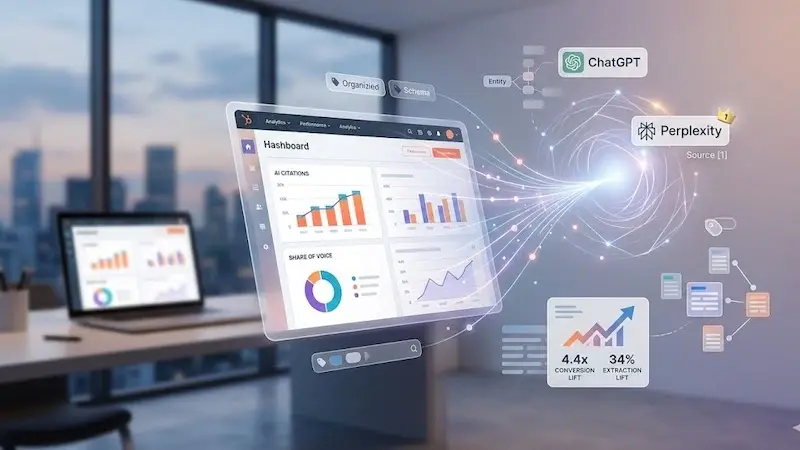
The Proof: Current benchmarks show that AI-referred visitors—those who click through a citation in ChatGPT or Perplexity—convert at 4.4x the rate of traditional organic search visitors.
-
What to Look For: Demand case studies that show “Inclusion Rates” and “Citation Frequency” rather than just “Page 1 Rankings.” A partner who can show you exactly how many times your brand was cited as a “Top 3 Recommendation” understands the landscape.
The Technical Backbone: HubSpot Schema Configuration for 2026
While content strategy is the “voice” of your GEO efforts, as we’ve already stated, Schema Markup is the nervous system. If your HubSpot partner isn’t talking about JSON-LD injection, they are missing the engine that drives AEO.
Moving Beyond Basic Tags
Most HubSpot partners can set up a basic Article schema. However, to win in a competitive GEO landscape, your configuration must be significantly more granular. Your partner should be implementing:
-
Speakable Schema: Essential for AI assistants (like Alexa, Siri, or Gemini Live) to recognize which parts of your content are best suited for text-to-speech responses.
-
FAQ Schema: This is the “fast track” to being featured in Google’s AI Overviews. By structuring your H2S as questions and the following paragraph as a suggested answer, you increase the probability of extraction by over 35%.
-
Author and Organization Entities: AI models weigh content based on the E-E-A-T (Experience, Expertise, Authoritativeness, Trustworthiness) of the source. Your schema must explicitly link your authors to their LinkedIn profiles and other authoritative publications to verify their expertise.
Implementing the “Knowledge Graph” via HubSpot
A sophisticated partner will use HubSpot Custom Properties and HubL to automate this at scale. Instead of manually adding code to every blog post, they should build a template that automatically generates a Knowledge Graph entry for every piece of content you publish.
Technical Data Point: Websites that utilize “SameAs” properties in their schema—linking their brand to established entities like Wikipedia, G2, and official social profiles—see an average 22% lift in brand citation frequency across generative search engines.
Timeline and Investment Expectations for GEO Work
GEO delivers results over time, not overnight. Set realistic expectations for how quickly you’ll see improvements in AI visibility and for the investment required to achieve your goals.
Your partner should be transparent about timelines and help you understand the milestones you can expect along the way. Avoid partners who promise immediate results—AI visibility builds gradually as you create content, earn citations, and strengthen entity signals.
What to Expect in the First 90 Days
In the first three months, expect your partner to complete an AI visibility audit, develop a GEO strategy, and begin optimizing your highest-priority content. They should also configure HubSpot tracking and establish baseline metrics.
You may see early wins in content structure and technical setup. However, significant improvements in AI citations typically take longer to materialize as AI platforms update their training data and algorithms.
Use this period to evaluate whether the partner communicates effectively, meets deadlines, and demonstrates the expertise they promised. Early execution quality predicts long-term success.
Long-Term GEO Investment Considerations
GEO is an ongoing discipline, not a project with a defined end date. Your partner should help you develop a sustainable approach that fits your budget and internal capabilities.
Consider how you’ll maintain and expand your GEO efforts over time. Some organizations build internal expertise with partner training. Others rely on ongoing partner support for specialized activities.
Budget for content creation, citation building, and periodic auditing. Also, budget for adaptation, as AI platforms evolve, your strategy will need to evolve.
Final Review: The 2026 GEO Partner Checklist
To conclude, let’s consolidate our “Final Gut-Check” into a definitive list. Use this to grade any potential HubSpot partner.
1. Strategy & Vision
-
[ ] Do they lead with AEO/GEO metrics (Citations, SoV) rather than just SEO metrics (Rankings, Clicks)?
-
[ ] Can they explain the impact of the 25% decline in search volume on your specific industry?
-
[ ] Do they have a strategy for Third-Party Consensus (G2, Reddit, Industry Journals)?
2. Execution & Implementation
-
[ ] Do they use Answer-First formatting (TL;DRs) to boost extraction probability by 34%?
-
[ ] Is their schema strategy granular enough to include Speakable and Entity-based tags?
-
[ ] Are they HubSpot certified specifically in the Content Hub and Operations Hub?
3. Measurement & ROI
- [ ] Can they build a HubSpot dashboard that isolates AI Referral Traffic?
- [ ] Do they report on Conversion Rate optimization (knowing AI traffic converts at 4.4x the standard rate)?
- [ ] Do they conduct Monthly AI Visibility Audits to track your brand’s sentiment in LLM responses?
Once you know what they’re capable of, you can make your final decision.
How Aspiration Marketing Approaches HubSpot and GEO
As a highly-rated HubSpot Solutions Partner, Aspiration Marketing brings together HubSpot implementation expertise with a deep understanding of content strategy for AI visibility. Our team connects your CRM data, content operations, and technical infrastructure to support your GEO goals.
We start every engagement with a needs assessment that includes AI visibility considerations. This means understanding not just your marketing and sales processes, but also how your target buyers research solutions using AI platforms.
Our HubSpot-certified experts configure your content management system, reporting dashboards, and workflows to support both traditional and AI-driven marketing outcomes.
Our Content Marketing Approach for AI Visibility
Aspiration Marketing’s content marketing services include AI-ready formatting as a standard practice. We structure every piece of content to maximize extraction potential while still engaging human readers.
Our writers understand how to craft answer-first content, use semantic triples that AI systems recognize, and include the specific details that earn citations. We also help you repurpose content across channels to build the consensus signals AI platforms value.
This approach connects directly to your HubSpot implementation. Content created for GEO flows through your marketing workflows, integrates with your lead nurturing sequences, and contributes to your overall inbound strategy.
Technical SEO and HubSpot Configuration
Our technical SEO work ensures your HubSpot-powered website supports GEO outcomes. We configure proper schema markup, optimize site speed and mobile performance, and ensure AI crawlers can access your content without barriers.
We also set up HubSpot’s reporting tools to track AI referral traffic and other GEO-specific metrics. This gives you visibility into how your investment in AI search optimization translates into actual business outcomes.
Our HubSpot implementation services include ongoing support to adapt your configuration as AI platforms evolve. The GEO landscape changes rapidly, and your HubSpot setup should evolve with it.
Final Thoughts
The transition from traditional search to AI-driven discovery is the most significant hurdle B2B marketers have faced in decades. Choosing a HubSpot partner is no longer about finding a vendor; it’s about finding a technical architect who understands the future of the “Answer Economy.”
We don’t just “do HubSpot.” We align your entire digital presence with the algorithms of tomorrow. By combining deep CRM expertise with a data-driven approach to AEO and GEO, we ensure that when your buyers ask the world’s most powerful AI engines for a solution, your brand is the answer.
If you’re ready to stop being a “blue link” and start being the cited authority, we’d welcome an introductory call to conduct your first AI Visibility Audit. Let’s build your growth strategy together.