Answer Engine Optimization (AEO): Advancing Rankings with FAQs

The landscape of digital discovery has shifted beneath our feet. We have officially moved past the era where search was a simple act of sorting through a directory of websites. Today, when you ask a question, you aren’t looking for a list of potential places to find information—you are looking for the information itself, delivered instantly and accurately.
Whether it’s an AI summary at the top of a results page or a direct response from a voice assistant, if a user actually visits your website for, your AEO strategy has already failed to become the definitive “Answer.”
This evolution has fundamentally changed how we approach visibility. We have moved from the traditional world of Search Engine Optimization (SEO) into the specialized realm of Answer Engine Optimization (AEO). While SEO focuses on ranking a page within a list, AEO focuses on providing structured, authoritative data that Large Language Models (LLMs) can digest, trust, and repeat.
One of the most effective ways to bridge this gap is by strategically using FAQs. Far from being a simple “help” section, the FAQ has become a high-performance engine for visibility. By formatting your expertise into a clear question-and-answer structure, you are effectively “teaching” AI models how to talk about your brand. In a world where search engines are becoming conversation partners, being the most helpful voice in the room is no longer an option—it’s a requirement.
The Rise of the Zero-Click Search in AEO
To understand why FAQs are so critical, we first have to look at how people search today. The “zero-click” search is no longer a fringe occurrence; it is the standard.
According to data from Semrush, roughly 25.6% of desktop searches and 17.3% of mobile searches now result in no click-through at all.
Why? Because the “Answer Engine”—whether it is Google’s SGE (Search Generative Experience), Perplexity, or ChatGPT—has already pulled the relevant data from a webpage and presented it as a summary. If your content isn’t easy for these engines to “clip,” you simply won’t appear in that summary.
Why FAQs are the “Perfect Food” for AI
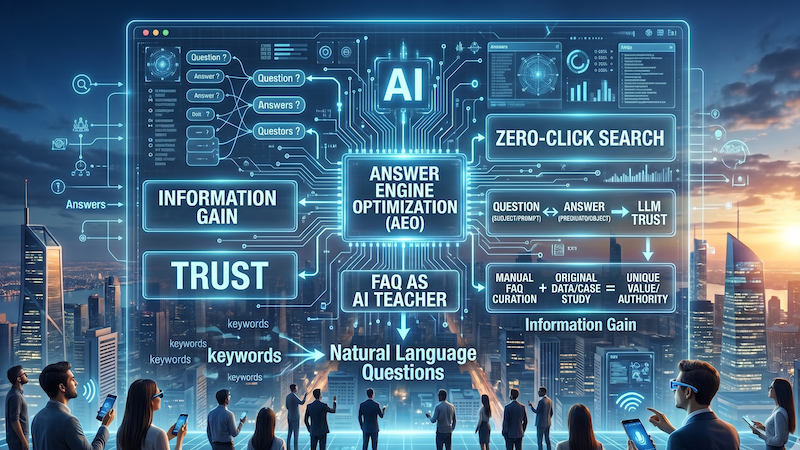
AI models are trained on patterns. They look for clear relationships between data points. In the world of linguistics and AI training, we often talk about the Semantic Triple. This is a simple structure consisting of a Subject, a Predicate, and an Object (e.g., “The Sky” + “is” + “Blue”).
An FAQ naturally follows this structure:
-
Question (Subject/Prompt): “What is AEO?”
-
Answer (Predicate/Object): “AEO stands for Answer Engine Optimization, which is the process of…”
By providing content in this format, you are doing the heavy lifting for the AI. You’re providing a pre-digested piece of information that the model can confidently serve to a user. This increases your “Share of Model”—a metric that measures how often an AI mentions your brand compared to your competitors.
Strategy 1: From Keywords to Natural Language Questions
Traditional SEO was obsessed with short-tail keywords. If you sold project management software, you wanted to rank for “project management tool.” In the AEO era, that is no longer enough. Users are asking questions like, “How can I track remote team productivity without micromanaging?”
To advance our AEO, we have shifted our research focus. We no longer just look at search volume for a word; we look at the intent behind the question.
The Data on Query Length
We aren’t just guessing that people are using more words.
Google reports that there is a clear upward trend in the length of search queries, from 1-2 words to 3-5+.
It was also noted in the same report that,
Short queries dropped from 42% in January to just 31% in June – suggesting users are increasingly communicating in more natural language.
As voice search becomes more accurate and AI chat interfaces become the primary way we interact with the web, the average query will continue to increase.
How to Implement This
When we build an FAQ section, we don’t just make up questions. We use tools to find out what people are actually asking. We look at:
-
People Also Ask (PAA) boxes are gold mines for AEOs.
-
Reddit and Quora: Where real people go to find answers that Google might be failing to provide.
-
Customer Support Logs: The questions your actual customers ask are the most valuable “FAQs” you have.
By addressing these specific questions, you aren’t just helping your SEO; you are providing a better user experience for someone in the consideration stage of their journey. They have a problem, and you are providing the direct solution.

Strategy 2: AI-Generated vs. Manual FAQ Curation
There is a lot of talk about AI-generated content, and for good reason. It is fast and scalable. But when it comes to AEO, a set-it-and-forget-it approach with AI can be dangerous.
The Role of LLMO (Large Language Model Optimization)
To truly stand out, we use a hybrid approach. We use AI to scan our long-form blog posts and whitepapers to identify potential FAQ candidates. An LLM can quickly spot where a paragraph is providing a definitive answer to a common industry question.
However, the “manual” part is where the magic happens. Google’s latest quality guidelines emphasize Information Gain. This is the idea that a piece of content should provide new, unique value that isn’t already present in the top ten results.
If your FAQ answer is just a rewrite of Wikipedia, an Answer Engine has no reason to cite you. But if your answer includes a specific case study, a unique statistic, or a proprietary framework, you become a high-value source for the AI.
Building Authority
When you manually curate your FAQs, you ensure your brand’s voice is present and that the information you provide is verified and presented in a natural and “human” way. You can be direct and approachable. You can ask the reader a question back: “Are you struggling with X? Here is how Y solves it.” This creates an engaging loop that moves the reader closer to a decision.
Strategy 3: The Technical Backbone of AEO
You can have the best answers in the world, but if the “bots” can’t read them, they don’t exist. This is where the technical side of AEO comes in.
The Power of Schema Markup
To make our FAQs visible to engines, we use the FAQPage Schema. This is a bit of code that tells a search engine, “Hey, this specific part of the page is a question, and this part is the answer.“
Think of it like a translator. The AI might be able to figure out your page on its own, but Schema is like giving it a map and a highlighter. When you use structured data, you significantly increase your chances of appearing in a “Featured Snippet.”
HubSpot has found that landing a Featured Snippet can lead to a 2x increase in click-through rates, even if the answer is displayed on the page.
It builds instant trust. If the search engine trusts you enough to put you in a box at the top, the user will trust you, too.
The “TL;DR” Advantage
In addition to FAQs, we often use a “TL;DR” (Too Long; Didn’t Read) summary at the top of our content. This serves a dual purpose. For the human reader, it provides a quick win. For the Answer Engine, it provides a perfect “abstract” of the entire page. It’s a concise, high-level FAQ that answers the primary question: “What is this page about and why should I care?”
Measuring Success in a “No-Click” World
The hardest part of shifting to AEO is changing how we measure success. For twenty years, “traffic” was the only metric that mattered. But today, traffic is only half the story.
If an AI engine answers a user’s question using your data, that user might never visit your site. Does that mean you lost? Not necessarily.
New Metrics for a New Era
We now look at:
-
Brand Mentions in AI Chat: How often does a user ask ChatGPT for a recommendation and get your name as the answer?
-
Sentiment of Citations: Is the AI presenting your brand as an expert or just a general source?
-
Engagement Rate: When users do click through from an FAQ or a snippet, are they staying? Usually, users coming from an AEO-optimized source have higher intent. They aren’t “browsing”; they are validating their choice.
We have to move away from “vanity metrics” like total clicks toward “authority metrics.” Are you the primary source of truth in your niche?
FAQs as a Tool for Trust (E-E-A-T)
In the consideration stage, the buyer is looking for a reason to trust you. They are comparing you to three other companies. They have doubts. They have “what-ifs.”
FAQs are the perfect place to address these head-on. A professional yet conversational FAQ section can demystify complex topics. Instead of using “marketing speak” or flowery language, an FAQ allows you to be direct.
-
Bad Answer: “Our solution leverages synergistic paradigms to optimize your workflow.”
-
Good (AEO) Answer: “Our software automates your data entry, saving your team an average of 10 hours per week.”
The Psychology of Directness
People trust people who give direct answers. By using a “Direct yet Approachable” tone, you position yourself as a helpful peer rather than a pushy salesperson. This builds the “Experience, Expertise, Authoritativeness, and Trustworthiness” (E-E-A-T) that both humans and search engines crave.
Putting it All Together: Your AEO Checklist
If you want to use FAQs to advance your own AEO, here is the roadmap we follow:
The Future of Discovery
As we look toward the rest of the year and beyond, the line between “searching” and “conversing” will continue to blur. The companies that thrive will be the ones that stop trying to “trick” the algorithm and start trying to “teach” the engine.
FAQs are the curriculum. They are the structured lessons that tell the world’s most powerful AI models exactly what you do, how you do it, and why you are the best at it. By embracing a data-driven, inquisitive approach to content, you ensure that when the Answer Engine speaks, it speaks your name.
At Aspiration Marketing, we have seen firsthand how this shift transforms a brand’s digital footprint. It isn’t just about being seen; it’s about being the definitive source of truth. We view AEO as the natural evolution of our commitment to growth and clarity. Our team specializes in bridging the gap between traditional SEO and the complex world of LLMO and AI visibility. We don’t just write for the web; we write for the future of how information is found and consumed.
The era of the “Answer” has arrived. Are you ready to provide it?