How Modern Buyers Decide Which Brands to Trust


A trustworthy image is one of the most valuable facets of a brand’s reputation. In fact, trust is so crucial that it directly influences all aspects of business success, across multiple stages of the sales cycle.
So, how exactly does trust influence buyer behavior? Data shows that credibility plays a significant role throughout the buyer’s journey. So, how does a brand build and increase trust?
According to research, consumers consider trust a key factor influencing purchasing behavior. Consider this:
-
88% of people find it to be as important as product price and quality, according to Edelman.
-
Salsify discovered that 68% of consumers are willing to pay more for products from brands they trust.
Of course, trust is not only rewarded with decreased price sensitivity.
Finally, it’s also worth noting that a trustworthy brand reputation can protect businesses from loyalty losses
-
According to Edelman, 67% of buyers are willing to remain loyal to and advocate for brands even when those brands make mistakes.
In other words, the importance and impact of brand credibility shouldn’t be much of a surprise for you — particularly if you’re aiming for business growth. Nevertheless, you might still have some questions about how modern buyers decide which brands to trust.
The simple answer to this question is that the process doesn’t just happen. Instead, trust is built and earned over time and across multiple interactions. It has to be continually maintained and justified by focusing on brand behaviors and characteristics that breed trust in the first place.
This article provides an overview of the methods modern buyers use to decide whether they can trust a business. Moreover, the guide presents a series of tactics you can implement in your marketing and branding strategies to boost brand credibility.
Let’s dive in.
Trust Is Formed Within Seconds; Make It Count
Consumer behavior research clearly indicates that people form brand opinions in seconds.
For example, when landing on a website,
Web users need only 50 milliseconds to form an impression of the brand. This includes all their views about brand credibility.
So, when aiming to earn customer trust and encourage your target audience to perceive your business as a competent and reliable organization, it’s crucial to accomplish these goals within seconds of their first interaction.
Web design can be exceptionally effective in doing this, particularly by highlighting high-value trust-building elements that showcase experience and expertise, and provide reassurance.
Of course, it’s not just credibility signals that earn customer trust. Professional design and the tone of your copy can also position your business as an industry authority within seconds of visitors landing on your site.
By incorporating powerful credibility signals into your online presence, you can instantly convince your target audience to perceive your brand as a trustworthy authority, maximizing their chances of engaging with your content and removing several of their conversion obstacles as they enter your sales funnel.
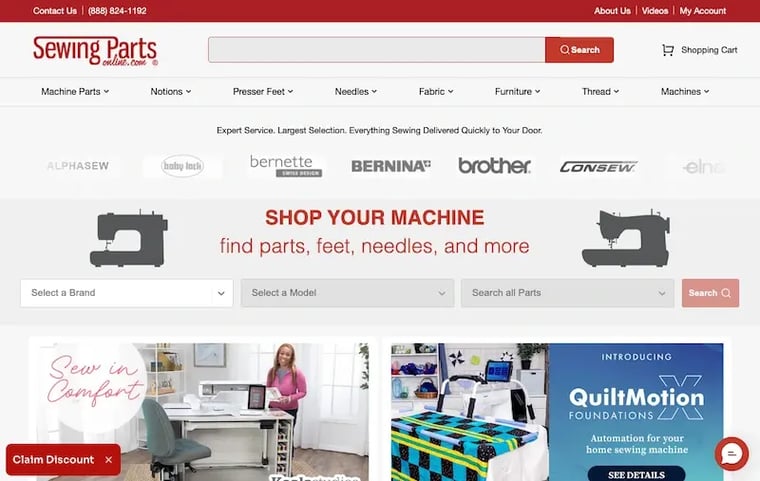
Check out how Sewing Parts Online implements this strategy on its website.
For starters, this brand’s online presence appears streamlined, professional, and easy to use. Secondly, the primary value proposition promises expert service, a wide selection, and quick delivery. When combined with additional credibility-building elements — like the educational content and social proof — these web design elements effectively build brand trust, emphasizing that Sewing Parts Online is a business customers can rely on to solve their pain points, regardless of whether they need new equipment, fabrics, or just a spare part for their existing sewing machine.
Visual Credibility Signals Matter as Much as What Brands Say
Value propositions — and branding copy, in general — can be exceptionally effective at earning customer trust. But here’s the deal about using text to build credibility: it’s not the fastest method.
According to psychological research, humans are far better at processing and comprehending visual data than text.
Some studies even state that people process visuals 60,000 times faster than written language. If you consider that 90% of all information processed by the brain is visual, this isn’t much of a surprise.
So, when exploring how modern buyers decide which brands to trust — and aiming to build credibility — visuals need to be a core element of your authority-boosting strategy.
What’s great is that incorporating visual trust signals into your online presence can be exceptionally easy. You can do it across multiple web pages and digital distribution channels, ensuring that all potential prospects see proof of your brand’s competence and reliability.

In addition to traditional social proof in visual formats (such as star ratings), consider incorporating more convincing visual elements into your online presence.
For example, third-party certificates are exceptionally important.
According to consumer behavior research, 85% of people trust third-party certifications.
This effectively shows the impact you could make by featuring certifications, awards, and similar trust-building badges.
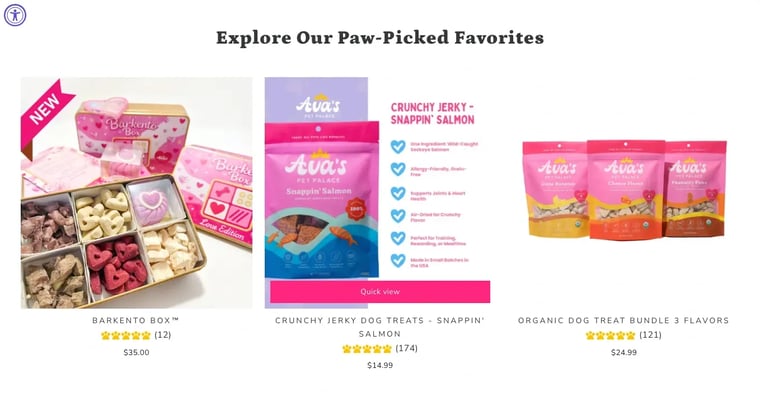
Check out how Ava’s Pet Place does this on its website.
For starters, this brand uses secondary product photos to communicate benefits such as organic ingredients, absence of allergens, and pet health benefits. In addition to doing this, the brand also displays third-party certificates in the footer of the homepage, where prospects can easily verify each claim, making them far more likely to trust Ava’s Pet Place to provide high-quality pet snacks that are genuinely healthy for cats and dogs.
Buyers Look for Proof Before Believing the Brand
One of the most prominent effects of market globalization is that businesses are investing increasing amounts of funding in their advertising campaigns. And while this does allow small or new businesses to break into competitive industries, it also means that consumers are exposed to an ever-growing number of marketing messages.
The issue is that the great majority of branded content isn’t completely truthful or trustworthy. As a result, buyers are far less likely to trust brands without proof.
According to research, consumers no longer automatically trust brands (and with good cause).
A study conducted by the European Commission discovered that 42% of environmental claims are false. Furthermore, just one in five consumers has confidence in sustainability claims.
So, how does this affect the way buyers decide whether to trust a business? Well, research suggests that most consumers look for proof before taking a brand’s value propositions at face value.
This tendency created a necessity to prioritize transparency and accountability in online branding. It also demonstrates that convincing prospects to enter and move through the sales funnel requires strong trust-building content that signals legitimacy — both by third-party entities and peers.
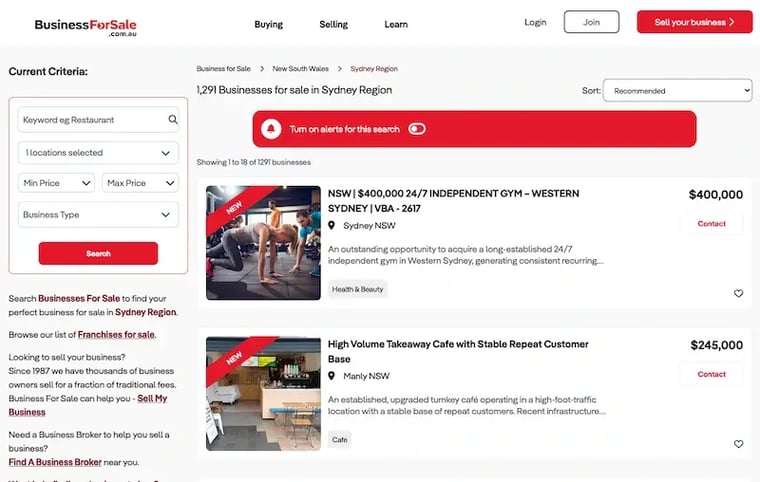
The Business for Sale website is an excellent example of how proof elevates trust in digital settings.
This business is highly regarded in its niche, which isn’t much of a surprise considering how long it’s been around. But a closer look at the brand’s website reveals that the secret to Business for Sale’s trustworthy reputation isn’t necessarily the organization’s longevity. Instead, it’s its approach to making credible claims above all else. In addition to showcasing a large volume of real listings and recognizable locations, this business is also transparent about prices.
These elements all signal legitimacy. They prove that Business for Sale works with genuine brands. Furthermore, the approach effectively makes new leads feel safe browsing the brand’s website, automatically guiding them toward a conversion.
Clarity and Transparency Reduce Perceived Risk
Brand trust and loyalty are inevitably linked to transparency.
According to consumer sentiment research:
What’s even more fascinating is that a lack of transparency — even when it comes to addressing social factors — can be perceived by shoppers as a red flag. In fact, research from Edelman found that,
When a business stays silent on a relevant issue, 53% of people will assume that it’s doing nothing or even hiding something.
That’s why it’s crucial to acknowledge the importance of clarity and transparency when studying how modern buyers decide to trust brands. They not only reduce shoppers’ perceived risk but also signal key aspects of a brand’s values and motivations. The latter is crucial in developing positive relationships with your target audience.
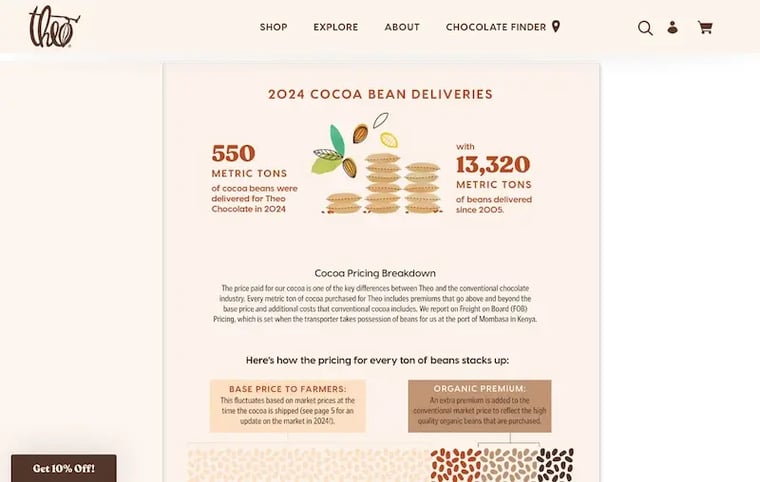
For example, Theo Chocolate does a beautiful job of nurturing customer trust through clarity.
This business doesn’t just make sustainability and ethical sourcing claims a key component of its marketing messages; it also makes them a key component of its operations. It goes so far as to provide customers with insights into the exact environmental impact of the brand and its products. With downloadable Impact Reports for each year, Theo Chocolate effectively incorporates transparency into its online presence, elevating its credibility and forging stronger relationships with ESG-conscious consumers looking to make buying decisions that can have a positive impact on their planet and communities.
Ease of Use Is Interpreted as Professionalism
While claims and marketing messages can and do elevate brand trust, they’re not always the only factors consumers use to judge businesses.
For example, scientific research clearly indicates a direct link between aesthetic and functional web design and brand trust, with some resources even suggesting that usability factors — such as security, consistency, ease of use, and reliability — significantly contribute to (or detract from) brand trust.
In truth, this shouldn’t be much of a surprise. After all, UX plays a major role in communicating brand professionalism and expertise. It’s an important predictor of customer experience, which many consumers prioritize when choosing what businesses to buy from.
So, when aiming to make it easy for your target audience to trust your brand, focus on providing web visitors with an enjoyable and streamlined user experience, which they will (ideally) interpret as professionalism and dependability.
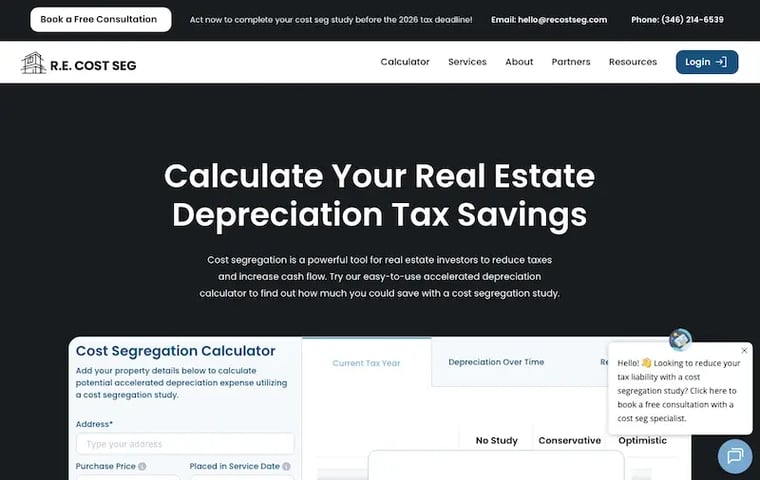
The Real Estate Depreciation Calculator on RE Cost Seg is an exceptional example of why this trust-building strategy works.
At first glance, this brand offers an exceptionally complex niche service that the majority of its target audience doesn’t fully understand. Knowing that informational value removes conversion obstacles, RE Cost Seg developed a calculator that allows web visitors to estimate the savings they could achieve on their real estate properties.
But here’s where UX comes into play. This calculator isn’t just a handy tool that addresses (and partially resolves) a customer pain point. It’s a highly usable, straightforward, and friction-free resource that provides prospects with value without forcing them to commit to a conversion, contact sales, or navigate complexity. The overall effect of such an approach is two-fold:
-
a clear brand image that depicts competence and credibility
-
demonstrating a dedication to customer satisfaction (even when it doesn’t result in profits for the brand)
Familiar Patterns Make New Brands Feel Safer
Lastly, when learning how modern consumers decide whether to trust businesses, it’s essential to remember the power of familiarity in shaping brand perceptions.
According to web user behavior analyses,
82% of people will choose a familiar brand for their first click when researching products online. Additionally, 73% of consumers are more likely to trust a brand they already know.
If you also consider that nostalgia can be a powerful conversion driver and positively impact brand loyalty, it quickly becomes evident that familiarity can be a core element in building brand trust.
While one of the primary methods for elevating familiarity relies on brand- and product-awareness-focused marketing strategies, it’s crucial not to disregard alternative ways to earn customer trust.
For example, something as simple as incorporating familiar patterns — whether in web design, product claims, or terms and conditions — can be exceptionally effective at making consumers feel safe when choosing new brands with no prior experience.
Alternatively, you could do something similar to AG1.
This brand understands the impact of familiarity on consumers’ buying decisions. That’s why it employs so many influencers and experts as spokespeople for its brand, knowing that their credibility is likely to boost the appeal of its products and remove prospects’ common conversion obstacles.

Final Thoughts
Consumers’ buying decisions aren’t random. They directly depend on several key factors, with trust being one of the main drivers of purchase intent. However, in a digital world where trust is declining across all fronts — including brand-customer relationships — identifying the right strategies for earning customer trust can be challenging.
The good news is that modern buyers share several considerations when deciding whether to put their trust in a brand. By understanding what makes consumers perceive a business as credible, you can actively optimize your company’s online reputation to align with your goals.
The tactics discussed in this article are all exceptionally effective. Yet, if you want next-level results, it’s crucial to align your marketing and branding efforts with your ideal customers’ primary trust considerations. That way, you’ll have an easier time convincing your audience to trust your brand. More importantly, you won’t seem like you’re trying too hard, which will make your efforts that much more productive.