Increase Trust With Credibility Building: Your Data-Driven Strategy


Are your most interested prospects getting stuck in the final stage—between evaluating solutions and committing?
You’ve successfully attracted them to your brand, shown them the benefits of your product, and maybe even started a conversation. But there’s a critical moment in the B2B or high-value B2C sales cycle where the spotlight shifts. The buyer is no longer asking, “Can this product solve my problem?” They are asking, “Can I trust this specific brand to deliver on its promise?” It’s the shift from interest to investment.
In the modern, saturated market, competency is assumed. You are professional enough just to be in the running. However, brand credibility is what separates a short-listed vendor from a long-term, trusted partner. Credibility is not a soft metric; it is a conversion metric. A lack of clear, demonstrable authority becomes an insurmountable obstacle to closing a deal.
This is especially true during the Consideration stage of the buyer’s journey. Your prospects are actively comparing you against competitors. They are looking for reasons to rule you out, and the easiest reason is a perceived risk. Therefore, your responsibility is to find a way to increase trust, and reassure the buyer that you are the right choice.
This article presents a strategic, data-driven framework—the Credibility-to-Conversion Roadmap—to help your brand move beyond mere professionalism and aggressively establish the digital authority necessary to increase trust and secure high-value partnerships significantly. We will show you how to embed trust into every part of your operation, making your brand the obvious, low-risk choice.
The Financial Imperative: Quantifying the Trust-to-Revenue Pathway
Why should you prioritize building credibility above all else right now? Because trust directly impacts revenue. Ignoring the need to build a rock-solid, verifiable reputation is simply too expensive. Finding ways to enhance brand credibility should be the first line item on your to-do list.
The Cost of the Credibility Gap
You may have the best product on the market, but if your website feels sluggish, your testimonials are outdated, or your pricing is unclear, prospects will quickly disqualify you.
We live in an era of intense consumer skepticism. Buyers, particularly B2B buyers, are evaluating vendors who might handle critical company data, manage operations, or integrate with existing systems. One credibility gap, and they are gone. They are not necessarily running to your competitor; they are running back to Google to continue searching for a company that appears to have its act together.
Ask yourself: How many prospects are abandoning your site because they perceive a single risk or vulnerability? How much is that hesitation costing your sales team?
Measurable Outcomes: Linking Trust to the Bottom Line
Trust is quantifiable. When you make strategic moves to increase trust, you can measure the results in higher conversion rates, greater customer lifetime value, and faster sales cycles.
Consider these hard facts on what consumers demand from credible brands today:
-
Transparency Drives Confidence: Research shows that a staggering 94% of consumers are more likely to be loyal to a brand when it commits to complete transparency. If you aren’t open about how you operate, you are losing valuable loyalty from almost nine out of ten potential buyers.
-
Consistency Breeds Reliability: Consistency also drives revenue. 60% of companies reported that being consistent in branding added 10% to 20% to their revenue growth. Any disconnect between your social media, website, and sales team instantly signals internal chaos, not reliability, and directly impacts your bottom line.
-
The Power of External Validation: When buyers are vetting a solution, they rely on others. In fact, 72% of consumers will take action only after reading a positive review. Credibility is collective, and if your social proof is lacking, your pipeline stalls.
These statistics confirm that strategic credibility building is, fundamentally, a sales enablement strategy. It smooths the path to purchase and lowers the perceived risk of choosing you.
Foundational Pillars: Architecting Your Digital Trust Infrastructure
A reliable brand is built on a dependable structure. To develop and increase trust, you must invest in the foundational elements that demonstrate your commitment to your customers’ success and security.
Strategic Transparency: Moving Beyond the Mission Statement
Transparency is more than just publishing your core values. It means being open about the practicalities of your business. Buyers in the Consideration stage want to know what they are getting into.
-
Data Protection and Privacy: Are You Safeguarding Your Clients’ Personal and Business Information? You must implement robust data protection measures and communicate them clearly to prospects. Don’t wait for regulation; be proactive. A clear privacy policy demonstrates responsibility and competence, making you a trustworthy partner.
-
Service Guarantees and Operational Honesty: If a service outage occurs or a mistake is made, how do you handle it? Proactive, clear communication during a crisis builds more trust than minimizing the issue or staying silent. Transparency in action means owning your strengths and your weaknesses.
-
Honesty in Fit: If your brand isn’t the right fit for a potential customer, guide them to a solution that is. This shows you care about their needs, not just making a sale. That genuine concern builds credibility and ensures they will return when the time is right, or recommend you to others.
Achieving Total Consistency Across All Channels
The modern buyer interacts with your brand across several channels before ever speaking to a salesperson. Credibility erodes instantly when your brand messaging is inconsistent across your website, social media feeds, and sales documents.
Consistency in your voice, visual identity, and core value proposition creates a sense of reliability and organizational maturity. When a brand looks, sounds, and feels the same everywhere, it signals stability and attention to detail.
Consider a case where a company’s glossy website promised an AI-driven, cutting-edge service, but its social media presence was characterized by casual, inconsistent posts that offered conflicting information. That disconnect screams “risky investment.” Consistency proves that your entire organization is aligned with the brand promise. It validates the revenue growth statistic we discussed earlier—it shows customers they can count on the same experience regardless of the interaction point.
Content as a Trust Vehicle: Promotion-Free Value
Credibility is sustained by demonstrating expertise before asking for a sale. This is the essence of modern marketing.
The goal is to use promotion-free content marketing to increase customer trust in your brand. You need to be a knowledgeable resource, helping prospects solve their problems through valuable content, industry insights, and educational materials.
-
The Inbound Mindset: Know exactly where your prospects are in their marketing funnel. If they are in the Consideration stage, they need comparison guides, case studies, and deep-dive technical documents. They do not need sales pitches.
-
The Credible Expert: Your content must be thoughtful and well-researched. Sharing information without reading it or commenting on topics without having done your homework comes across as disingenuous. Every piece of content you produce should demonstrate that your team is comprised of thoughtful, authoritative leaders who value helping the audience over securing an immediate sale. The trust established through this slow, deliberate process is enduring.
Actionable Tactics: The Credibility Acceleration Checklist
Foundational integrity is key, but you also need to use specific, high-impact elements to accelerate digital trust and credibility instantly. This checklist focuses on elements that aggressively persuade the Consideration-stage buyer.

External Validation: Borrowing Credibility from Thought Leaders and Press
Self-promotion is necessary, but media coverage and peer recognition carry a weight that you cannot manufacture yourself. When a recognizable outlet or journalist writes about your company, it signals that external, vetted sources found you newsworthy.
-
Display Authority: Create a dedicated section on your homepage and key landing pages showing logos of publications that have featured you. This tactic borrows credibility from established sources. A buyer might not know your brand yet, but they recognize a prestigious publication, and the association instantly transfers trust.
-
Engage with Authority: Your strategy should also include actively engaging with thought leaders in your industry. By sharing, commenting on, and referencing their expert content, you demonstrate that your brand understands and values the broader conversation. This positions you as an active, informed participant, not an isolated newcomer.
-
Be Specific: Link each logo or reference directly to the actual article when possible. This proves the mention is genuine and allows interested prospects to explore the full coverage, building deeper confidence in your brand.
The Power of Verified Social Proof and Certifications
Social proof is simply evidence that others have trusted you and been rewarded for it. However, it must be verified, recent, and relevant to the buyer’s context.
-
Showcase Recent Success: Highlight recent awards and industry certifications. A “Best of 2018” badge in the current year suggests your company peaked years ago. Focus only on recent wins.
-
Certifications as Competence: Certifications demonstrate that you take standards seriously enough to pursue formal, independent validation. Display relevant certifications prominently, often in the site footer, and link them to verification pages whenever possible. This lets skeptical buyers confirm your credentials.
-
Example (Slack): Look at how companies like Slack strategically use quantifiable external recognition. They state they have earned recognition as a market leader over 340 times and back that claim with visible badges from recent awards. This approach combines quantity with verifiable proof, providing prospects with both the big picture and the specific details they need to build trust.
Eliminating Friction: Implementing Radical Price Transparency
Hidden pricing is one of the biggest killers of B2B conversions. Buyers in the Consideration stage are qualifying vendors based on budget before they invest time in demos or discovery calls.
Avoiding transparent pricing signals that you are either afraid of sticker shock or have a convoluted, non-standard model. Either way, it raises a red flag.
The impact of transparency is dramatic: Strategic pricing display can have a massive impact on your conversion efficiency.
Companies that display pricing clearly can see conversion rates double compared to those that gate this information behind contact forms.
-
The Action: If you have standard tiers, display them clearly. Display the price, included features, and the target audience for each tier. If your product requires custom scoping, please provide starting points or an estimate of the factors that affect the cost.
-
The Rationale: Pricing transparency respects the buyer’s process. When prospects can self-qualify based on cost, you filter out bad-fit leads and attract serious buyers who already know they can afford you.
-
Example (Gusto): Companies like Gusto, which provides payroll software, prominently display their pricing. They clearly list the monthly cost per employee for each plan. This allows visitors to immediately determine whether the solution meets their needs and budget, which significantly speeds up the qualification process for both parties.
Case Study: Apex Solutions – Accelerating Conversions Through Digital Authority
This case study illustrates the effectiveness of transitioning from self-promotion to verified digital authority, leading to measurable improvements during the critical Consideration stage.
The Client and the Challenge
Client: Apex Solutions, a B2B SaaS provider specializing in complex data compliance software.
The Problem: Apex Solutions successfully generated high traffic (Attraction/Awareness stage) but struggled with a severely low Lead-to-Opportunity conversion rate (Consideration stage). Prospects were visiting the website, reading the content, but leaving before initiating contact.
The credibility gap was identified across three key areas:
Aspiration Marketing Methodology: The Credibility-to-Conversion Roadmap
In this instance, this is how we’d implement a strategic program focused on eliminating friction and aggressively building verifiable trust metrics, directly addressing the Consideration-stage pain points. We’ve also demonstrated which steps outlined in this blog would be used and how.
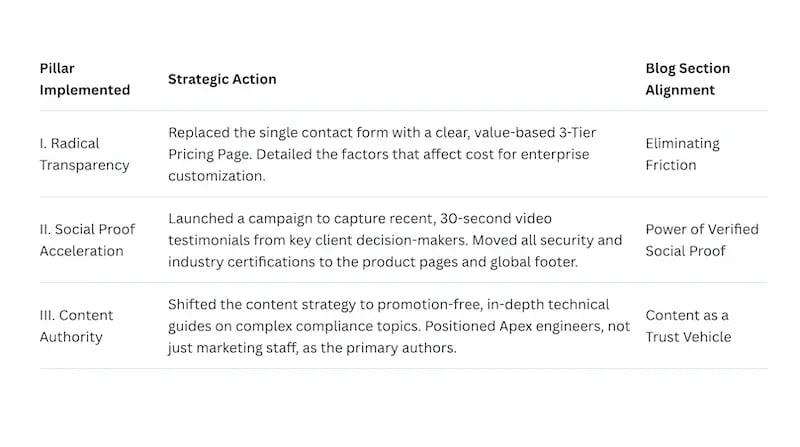
Measurable Outcomes and Strategic Insights
By addressing the credibility gaps with data-driven strategic insights, Apex Solutions would see immediate, significant changes in performance:
1. Lead-to-Opportunity Conversion Rate
The most critical metric—the number of qualified leads progressing to a sales engagement—increased dramatically.
Result: The Lead-to-Opportunity Conversion Rate for visitors who viewed the new pricing page increased by 48% within the first quarter.
Insight: Removing pricing friction allowed serious buyers to self-qualify instantly, funneling high-intent, budget-aligned prospects directly to the sales team and saving qualification time.
2. Reduction in Sales Cycle Length
Because prospects arrived with pre-vetted pricing knowledge and a higher degree of trust, the sales team spent less time overcoming initial skepticism.
Result: The average sales cycle length reduced by 19 days (approximately 17%).
Insight: The visible certifications and verified video testimonials acted as crucial pre-conversion validation, giving the sales team a significant advantage during initial calls.
3. Increased Credibility Element Engagement
The transparent and authoritative elements became high-engagement areas of the website.
Result: Time-on-page for the Testimonials and Certifications sections increased by 65%, indicating buyers were actively seeking proof.
Insight: Buyers need permission to choose you. When transparent information and social proof are easy to find, they facilitate the purchase decision by reducing risk and satisfying the inherent need to “do their homework.”
The methodologies implemented by Aspiration Marketing prove that focusing on verifiable trust metrics provides the necessary strategic insights to unlock stalled pipelines. Our tools and frameworks are designed to build a measurable, scalable digital authority that converts consideration into commitment.
Increasing Trust with Proven Methodologies
Building credibility is not a quick fix or a single project. It is the result of continuous, strategic execution across multiple digital touchpoints. We have outlined a clear roadmap, backed by data, to transform prospect skepticism into confidence and significantly increase trust among your most valuable buyers.
From radically transparent pricing to consistent messaging and verified external validation, these elements combine to build a digital presence that is perceived as low-risk and high-reward. The outcome is not just a better brand image, but a faster sales cycle, higher conversion rates, and better customer lifetime value—all measurable results of superior brand credibility.
Achieving this level of digital authority and securing these measurable outcomes requires more than effort—it requires a proven methodology, strategic insights, and specialized tools. This is where a partnership focusing on real-world examples of successful trust-building is essential. By leveraging strategic frameworks, we at Aspiration Marketing have consistently helped businesses implement these processes to drive growth and conversion, positioning our tested methodologies as the critical asset for your brand’s next phase of expansion.