The Buyer’s Journey: Navigating Buyer Considerations

Are you truly influencing your potential customers, or are you just playing catch-up with their independent research?
In today’s digital landscape, the power dynamic in sales has irrevocably shifted. Buyers no longer wait for a sales pitch; they demand high-value information at their convenience. This makes the Consideration Stage of the Buyer’s Journey the most critical moment for modern marketing and sales teams.
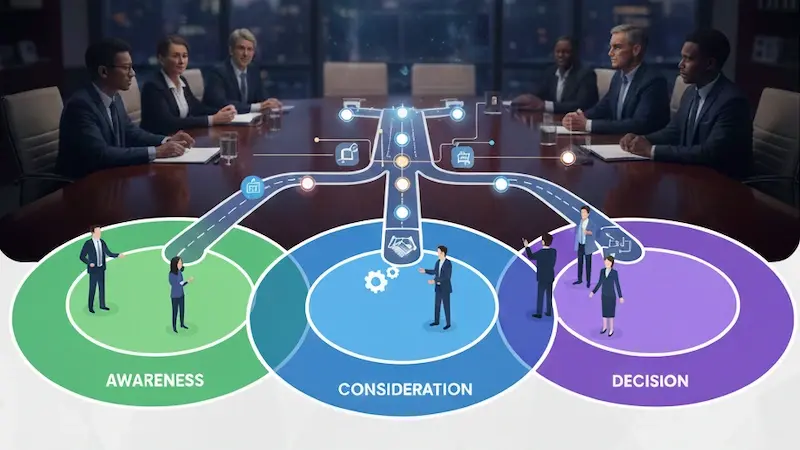
The Consideration Stage is the evaluation phase. It is the point where a prospective customer moves from identifying a pain point to actively evaluating potential solutions. It is where their list of options takes shape, and critically, where their personal and professional buyer considerations are defined, weighed, and used to create a shortlist.
Winning in this phase means more than just having a solution. It means being the most credible, accessible, and transparent resource during the buyer’s rigorous investigation and navigating buyer decisions.
The Self-Sufficient Buyer and the Consideration Gap
To understand how to win the Consideration Stage, we must first accept a data-driven reality check.
The modern B2B buyer is overwhelmingly self-reliant. They are digital natives in their research, and they avoid unsolicited contact.
Research shows that most B2B buyers are 57% to 70% of the way through their decision-making process before they ever engage with a sales representative.
Think about that statistic for a moment. By the time a prospect answers an email or takes a meeting, the majority of the research has already been completed. The critical selection criteria have already been established. Your goal, therefore, cannot be to sell; it must be to strategically guide that research, providing high-value content that anticipates every single one of the buyer’s criteria.
Success in navigating buyer considerations requires marketers to pivot from selling solutions to intelligently supplying evidence.
Deconstructing the Digital Fortress: The Anatomy of Buyer Research
What does this rigorous, independent research process actually look like? It is intense, exhaustive, and collaborative.
The Research Marathon: Why Buyers Consume More Content
Buyers at the Consideration Stage are not skimming; they are auditing. They are looking for depth, detail, and direct comparison. This search for evidence naturally results in a massive increase in content consumption compared to the earlier, more abstract Awareness Stage.
Why do they need so much content? They are building a case for their decision—a case they must present to others.
The volume is staggering:
Buyers consume 47% more content during the consideration stage than at any other point in the journey. Furthermore, the average B2B buyer interacts with 11 to 13 pieces of content before making a purchase decision.
This means a single, compelling blog post is never enough. You must construct an entire library of interconnected resources that address every possible angle of their evaluation.
Consider the difference between Awareness content, which might ask:
“What is the impact of inefficient logistics?“
And Consideration content, which asks:
“How does System A compare to System B in mitigating international shipping delays, and what is the 90-day ROI?“
The shift is from abstract problems to tangible, verifiable solutions.
The Multi-Stakeholder Challenge
Adding another layer of complexity to buyer considerations is the fact that the buying decision rarely rests on one person. Buying is a team sport.
The average B2B buying group now involves 8 to 11 stakeholders.
This reality is why a simple one-size-fits-all approach fails. Every person—from the end-user who needs practical functionality to the CFO who only cares about the economic impact—has a different set of buyer considerations to satisfy.
-
IT Leaders: Need technical specifications, security protocols, and integration guides.
-
End-Users/Department Heads: Need detailed product demonstrations, ease-of-use statistics, and training documentation.
-
Finance/Executive Teams: Need clear ROI reports, total cost of ownership (TCO) analyses, and vendor stability reports.
Your content strategy must acknowledge and cater to this complex dynamic, ensuring no stakeholder is left behind.
Defining Core Buyer Considerations: The Metrics of the Shortlist
Once a buyer has consumed the initial content, how do they narrow down their list? What truly drives the shortlisting process?
Beyond Features: The ROI and Value Proposition
When a buyer enters the Consideration Stage, they are evaluating solutions that can technically solve their problem. Therefore, the decision pivots quickly from “Can it do the job?” to “Will it justify the investment, and what is the measurable value?”
The primary criteria for B2B decisions are not just technical specifications; they are economic. They revolve around:
-
Clear ROI: What is the expected return, and how quickly?
-
Improved Efficiency: How many hours will this save my team?
-
Competitive Advantage: How does this position my business better than my rivals?
-
Total Cost of Ownership (TCO): What are the hidden costs of integration and maintenance?
If your content focuses solely on features without translating them into a clear economic benefit, you will lose to the competitor who makes the value proposition impossible to ignore.
The Power of Proof: Leveraging Social Validation
In a world filled with marketing noise, peer validation is the strongest, most trusted source of truth. Buyers are inherently skeptical of vendor claims; they trust the experience of other customers.

Social proof is not a nice-to-have; it is a necessity.
Over 77% of buyers read user reviews, and word-of-mouth recommendations carry the highest weight in the decision-making process.
This is the moment to move beyond simple testimonials. While a testimonial provides reassurance, a detailed case study provides the necessary evidence to support it. A case study translates an abstract solution into a tangible, metrics-backed result by demonstrating the successful implementation and quantifiable results achieved by a similar client. It answers the ultimate question in the Consideration Stage: “Will this actually work for my specific situation?“
The Consideration Content Toolkit: Fueling the Decision
To address these complex buyer considerations, marketers must deploy a strategic content toolkit that focuses on depth, evidence, and clarity.
Case Studies as the Ultimate Proof Point
We have established that case studies are essential, but their execution is vital. A strong case study must include:
-
The Challenge: A clear outline of the client’s problem (the buyer must be able to relate to this).
-
The Solution: The specific strategy implemented.
-
The Results: Quantifiable metrics (e.g., “reduced churn by 20%,” “increased pipeline conversion by 45%”).
These documents serve as internal validation tools for the buying committee, giving them the evidence needed to advocate for your solution.
Comparison Guides and Data Sheets
Comparison guides are often the most heavily consumed content in the Consideration Stage because they directly address the task of shortlisting. To be effective, they must be objective. Even if the vendor strategically highlights their strengths, the comparison must appear fair and transparent. Use clear charts and visuals to simplify complex comparisons, allowing stakeholders to grasp the key differences quickly.
The Non-Negotiable Role of Video Content
Video is no longer an optional add-on; it is a requirement for delivering complex information efficiently and building emotional connection.
95% of B2B buyers say video content plays a crucial role in their purchasing decision.
Video content in this stage should include:
-
Product Demonstrations: Walkthroughs focusing on specific use cases and features.
-
Expert Q&A Webinars: Live or recorded sessions that allow buyers to “meet” the team and address technical concerns.
-
Personalized Walkthroughs: Brief, tailored videos addressing specific questions a buyer may have submitted.
Overcoming Friction: Aligning Experience with Expectation
Even with perfect content, a poor user experience can derail the entire Buyer’s Journey. Friction creates doubt and drives customers toward competitors.
The Mandate for Radical Transparency
One of the largest sources of B2B buyer frustration is a lack of transparent pricing.
Pricing ambiguity suggests complexity, hidden fees, or a sales process that will be needlessly difficult. Marketers must combat this by providing clear pricing structures, implementation timelines, and honest feature roadmaps. If pricing is customized, the content must clearly outline the factors that influence the final cost.
Moving Past Irrelevance: Hyper-Personalization in the Funnel
Generic content is actively detrimental in the Consideration Stage. Buyers expect tailored experiences that acknowledge their industry, company size, and previous engagement history.
For example, suppose a buyer has downloaded an ROI guide for the manufacturing sector. In that case, the following pieces of content they see should focus only on manufacturing case studies and implementation specifics for that industry. This hyper-personalization shows that your solution is not just a solution, but the right one for their specific context.
Optimizing the Digital Experience
Ensure your technical platform reflects the professional standards of your solution. Slow page loads, confusing navigation, or poor mobile experiences create friction that drives potential customers away. If accessing your research content is difficult, the buyer will assume working with your company will be equally tricky. The digital experience must be seamless, fast, and intuitive.
Shifting from Selling to Strategic Guidance
The Consideration Stage is not a selling opportunity; it is an academic audit. The buyer is in control, armed with an internal committee, a detailed checklist of buyer considerations, and a mandate for low-risk, high-reward solutions.
Success is defined by your ability to anticipate those criteria and supply the exact, quantifiable evidence needed for the decision. This requires a dedicated, data-driven content architecture focused on transparency, social proof, and deep relevance.
Are you building content that merely describes your solution, or are you creating resources that actively validate your business case?
Aspiration Marketing specializes in developing data-driven content strategies that turn complex buyer criteria into compelling, conversion-focused narratives. We help you move beyond surface-level engagement to truly inform and influence those critical buyer considerations, ensuring your solution is the clear, de-risked choice on the final shortlist. Partner with us to architect a consideration stage that guarantees alignment, confidence, and conversion.