Moving to a Lifecycle Revenue Model

Think about the last time you felt genuinely valued as a customer. Was it the moment you saw a flashy advertisement? Was it the split second you clicked “buy” on a website? Or was it three months later, when the company reached out with a helpful tip explicitly tailored to how you use their product?For decades, businesses have operated under a singular, linear obsession: the sales funnel. We have been taught to pour resources into the top, widen the mouth as much as possible, and measure success by how many people reach the bottom. But here is the problem: in a modern economy, the bottom of the funnel is a dead end.
If your organization is currently treating the “Closed-Won” notification as the finish line, you aren’t just missing opportunities—you are likely losing money. The traditional funnel is built for a world that no longer exists. Today, the most successful companies are abandoning the linear path in favor of a Lifecycle Revenue Model. By shifting to customer lifecycle marketing, these organizations are transforming their customers into the primary engine of their growth, rather than merely the final output.
In this guide, we will explore why the traditional funnel is fundamentally flawed, how the “flywheel” or loop marketing concept offers a more effective path, and how you can implement a revenue model that sustains itself for years to come.
The Fundamental Flaw: Why Linear Thinking Fails
The traditional sales funnel was designed in an era where information was scarce. Back then, a salesperson’s job was to be the gatekeeper of knowledge. They guided the prospect through a rigid, one-way journey. Once the sale was made, the “funnel” ended, and the customer was handed off to a different department, often disappearing from the marketing team’s radar entirely.
This “start-stop” energy is the greatest weakness of the funnel. Because it is linear, it lacks momentum. Every month, your marketing and sales teams have to start over at zero. They must find new leads, convince new skeptics, and combat rising costs.
The Financial Reality of Acquisition
The most glaring reason the funnel is broken is the cost. It is a fundamental truth in business that acquiring a new customer is significantly more expensive than retaining an existing one.
According to data from the Harvard Business Review, acquiring a new customer can be anywhere from 5 to 25 x more expensive than retaining an existing one.
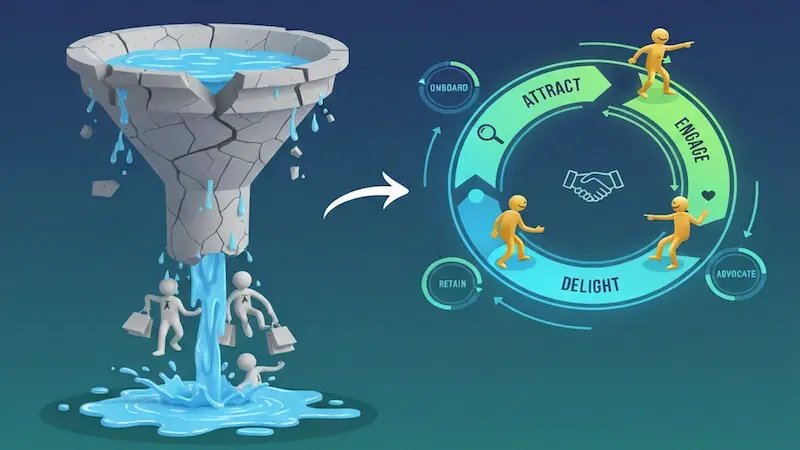
When you focus 90% of your energy on the top of the funnel, you are essentially paying a massive premium for every dollar of revenue. If that customer leaves after a year because you stopped marketing to them the moment they signed, you may never even recoup the initial cost of acquiring them. This is the “Leaky Bucket” syndrome. You can pour as much water as you want into the top, but if the bottom is open, you will never achieve true scale.
The “Handoff” Problem
In a funnel-based organization, departments often work in silos.
This creates friction. The customer feels a shift in tone and expertise at every handoff. In a world where customer experience is the primary brand differentiator, these cracks in the journey lead to churn. Does your customer feel like a partner, or just another transaction passing through a pipe?
Enter the Flywheel: The Power of Loop Marketing
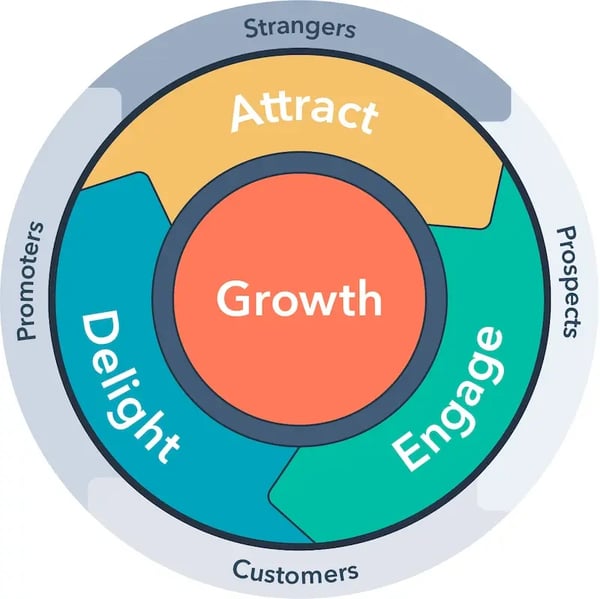
If the funnel is a pipe, the lifecycle revenue model is a wheel—specifically, a flywheel. In physics, a flywheel is a heavy wheel that requires a significant amount of effort to start spinning, but once it’s in motion, its own momentum keeps it moving.
This is the core of Loop Marketing. Instead of losing energy at the bottom of a funnel, you reinvest that energy back into the top. Your customers aren’t just an output; they are the fuel.
The Three Forces of the Flywheel
To turn your funnel into a flywheel, you must focus on three distinct actions that happen simultaneously across the entire customer lifecycle:
-
Attract: You provide value before you ask for it. This isn’t just about ads; it’s about being a thought leader and a helpful resource.
-
Engage: You make it easy for people to learn about and buy from you on their own terms.
-
Delight: You go above and beyond to ensure the customer actually achieves the goals they had when they bought your product.
The magic happens in the delight phase. When a customer is delighted, they don’t just stay; they talk. They write reviews. They refer their peers. This creates a “loop” where your current customers are actually doing the work of your marketing and sales teams.
The statistics back this up.
Research from Bain & Company suggests that increasing customer retention rates by just 5% can increase profits by 25% to 95%.
Why such a huge jump? Repeat customers have a higher Lifetime Value (LTV), lower support costs, and a much higher likelihood of trying your new products or services.
What is the Lifecycle Revenue Model (LRM)?
Moving to a lifecycle revenue model means mapping every single touchpoint a human has with your brand, from the first time they hear your name to the day they become your most prominent brand advocate. It is a holistic approach driven by Revenue Operations (RevOps) that treats revenue as a continuous cycle rather than a series of one-off events.
Let’s break down the stages of a healthy, circular lifecycle.

1. Awareness and Discovery (Education First)
In the awareness stage, the goal isn’t to sell features; it’s to acknowledge the customer’s pain. This is where customer lifecycle marketing begins. You are providing the answers to the questions your prospects are searching for at 2:00 am. By being the first to provide value, you earn the right to be the one they choose when they are ready to make a purchase.
2. The Evaluation Gap
Most funnels fail here because they push for a “close” too early. A lifecycle model uses data to ensure the prospect is a good fit. Why? Because closing a bad-fit customer is a guaranteed way to increase your churn rate and damage your reputation. RevOps helps align marketing and sales so that only high-quality, high-retention-potential leads are prioritized.
3. The Critical Onboarding Phase
If the funnel ends at the sale, the onboarding phase is often neglected. However, this is arguably the most critical part of the entire journey.
According to Retently, poor onboarding is the cause of up to 23% of average customer churn.
If a customer doesn’t experience “Value Realization” (the “Aha!” moment) quickly, they will stop using the product. A Lifecycle Revenue Model treats onboarding as a high-stakes marketing and sales event. You are “re-selling” the customer on the value of their decision every day during those first 90 days.
4. Retention and The “Expansion” Engine
This is where the traditional funnel falls short. In a linear model, there is no “post-sale” marketing. In a lifecycle model, this is where the real revenue is generated.
According to the KeyBanc SaaS Survey, upselling and expanding existing customers can account for 70% to 95% of total revenue growth for top-performing companies.
It is much easier to sell a new module or a higher tier to someone who already uses and loves your service than it is to find a stranger and convince them to trust you for the first time.
5. Advocacy: Turning Customers into Salespeople
The final stage of the loop is advocacy. When you have a systematic way to identify and empower your happiest customers, your “Attract” stage becomes much more efficient. Case studies, testimonials, and referral programs aren’t just “nice to have”—they are the gears that keep the flywheel spinning.
Why Acquisition-Only Strategies are a Risky Gamble
Many leaders hesitate to shift focus away from acquisition because it feels like they are taking their foot off the gas. However, in reality, an acquisition-only strategy is akin to trying to fill a bathtub without a drain plug. You might get the water level up for a moment, but it is an exhausting and expensive way to bathe.
The Net Revenue Retention (NRR) Revolution
In the world of RevOps, the metric that matters most today is Net Revenue Retention (NRR). This measures how much your revenue grows or shrinks from your existing customer base. If your NRR is over 100%, it means you are growing even if you don’t sign a single new customer this month.
Companies that stay stuck in the “funnel” mindset rarely achieve high NRR. They are too busy chasing the next lead to notice that their current customers are unhappy. By the time they realize there is a problem, the churn has already eroded their growth.
The Social Proof Economy
We live in an age of radical transparency. Sites like G2, Capterra, and even LinkedIn mean that a company’s “marketing” is no longer what the company says about itself—it is what its customers say about it. If you ignore the post-sale lifecycle, you lose control of your brand narrative. A Lifecycle Revenue Model ensures that you are constantly nurturing the relationships that lead to positive public sentiment.
Steps to Implement a Lifecycle Revenue Model
If you are ready to stop “pouring” and start “looping,” how do you begin? It requires a shift in both technology and culture.
-
Break the Silos with RevOps. You cannot have a circular model if your departments don’t talk. Revenue Operations is the glue. It ensures that the Customer Success team has access to the same data the Sales team used to close the deal. It ensures that Marketing knows which features the customers are actually using, so they can create better educational content.
-
Audit Your Post-Sale Content: Review your website and email automation. How much of it is directed at people who haven’t made a purchase yet? Now, how much of it is directed at helping your current customers become experts? If the ratio is 90/10, you have work to do. Customer lifecycle marketing requires a library of content tailored to every stage, including onboarding guides, advanced use-case webinars, and community forums.
-
Incentivize Retention, Not Just Closing. Check your compensation structures. Are your sales reps rewarded for the long-term health of the account, or just the signature? If you want to adopt a Lifecycle Revenue Model, your team’s incentives must align with the value of the entire journey.
-
Measure What Matters. Move beyond “MQLs” (Marketing Qualified Leads). Start looking at “Time to Value,” “Customer Health Scores,” and “Expansion Revenue.” These are the metrics that indicate whether your flywheel is actually gaining momentum.
The Future of Growth is Circular
The era of the “disposable” customer is over. In a crowded marketplace where buyers have endless choices, the only way to build a sustainable, profitable business is to treat every customer as a lifelong partner.
The funnel was a helpful metaphor for a long time, but it is too rigid and too wasteful for the modern world. By embracing loop marketing, the fundamentals of revenue operations (which we’re calling RevOps 101), and the lifecycle revenue model, you stop fighting against market friction and start using your own success to drive future growth.
It is time to stop thinking about how to “get” customers and start thinking about how to “keep” and “grow” them. When you fix the leak in the bucket, you’ll find that you don’t need nearly as much water to keep it full.
Building a sophisticated revenue engine isn’t something you have to do alone. At Aspiration Marketing, we specialize in helping companies navigate these complex shifts. We believe that growth shouldn’t be a struggle; it should be a sustainable, repeatable process. From refining your RevOps strategy to crafting customer lifecycle marketing that resonates, we help you transition from a broken funnel to a high-performance flywheel.
The question is no longer “How many leads can we get?” It is “How much value can we create?” When you answer that second question, the revenue will follow.